
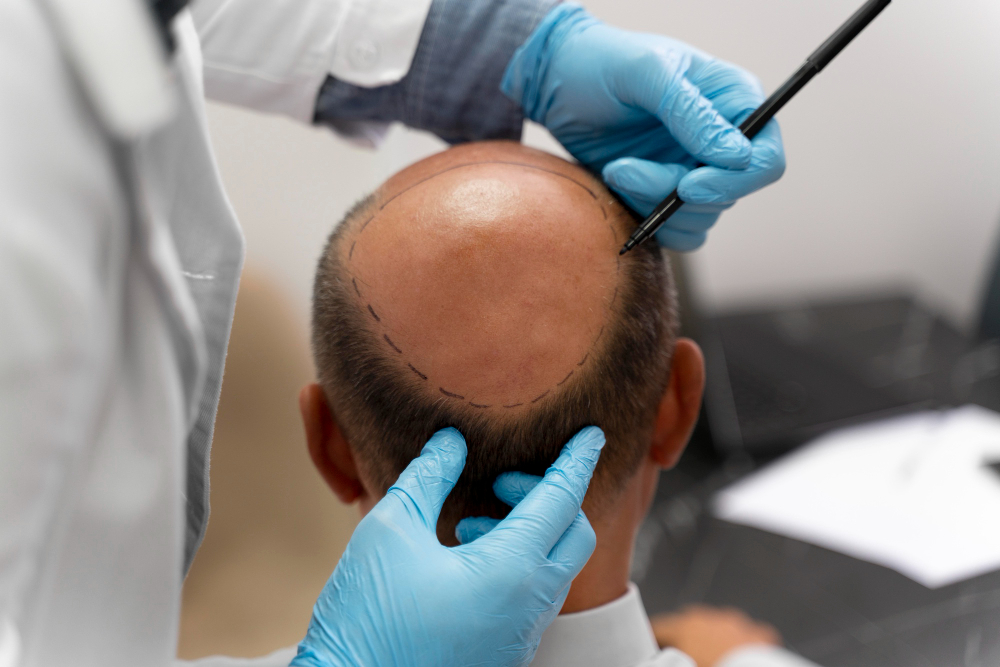
Quick tip: Sapphire FUE uses sapphire crystal blades to create finer, V-shaped sites, which can mean cleaner incisions, faster recovery, and higher density when done by an experienced team.
What Is Traditional FUE?

Follicular Unit Extraction (FUE) is a minimally invasive technique where individual follicular units are harvested from a donor zone—typically the back and sides of the scalp—and implanted into thinning or balding areas.
- No linear scar; tiny dot-like extractions.
- Local anesthesia, day-care procedure, and relatively quick recovery.
- Natural-looking hairline design possible with skilled angulation.
Common limitations of steel-blade FUE
- Recipient sites often created with steel blades (U-shaped channels), which can cause slightly more tissue trauma.
- Healing may take a little longer compared to sapphire blades.
- Micro-scarring and graft-angle variability if not executed precisely.
What Is Sapphire FUE?

Sapphire FUE uses blades made from synthetic sapphire crystals to open recipient sites. These blades are exceptionally sharp and smooth, allowing precise incisions that can match the graft size more closely.
Why clinics favor sapphire blades
- Precision: Cleaner, more uniform sites can improve graft fit and direction.
- Tissue-friendly: Less lateral trauma may support faster recovery and reduced swelling.
- Density potential: Tighter site spacing can help achieve higher natural density where indicated.
Note: Outcomes depend heavily on surgical planning and the team’s experience—tools amplify skill; they don’t replace it.
Sapphire FUE vs Traditional FUE: Key Differences

| Factor | Traditional FUE | Sapphire FUE |
|---|---|---|
| Incision Tool | Steel blades | Sapphire crystal blades |
| Channel Shape | U-shaped | V-shaped |
| Healing Window* | ~7–10 days | ~5–7 days |
| Tissue Trauma | Slightly higher | Lower (cleaner cuts) |
| Density Potential | Good | Higher, when indicated |
| Typical Cost | More affordable | Slightly higher (tooling & expertise) |
* Actual recovery varies by patient, graft count, and aftercare compliance.
Which Method Should You Choose?

- Budget: Sapphire FUE usually carries a premium due to equipment and training.
- Goals: If you want maximum density with minimal downtime, sapphire may be worth it.
- Experience matters most: Outcomes depend more on the team’s planning, angle control, and placement technique than on the blade alone.
Book a Consultation : 918553954466
FAQs: Sapphire FUE vs Traditional FUE
Is Sapphire FUE less painful than traditional FUE?
Both use local anesthesia. Many patients report similar intraoperative comfort; some experience less post-op swelling with sapphire due to cleaner incisions.
Will Sapphire FUE guarantee higher density?
It enables tighter site spacing, but true density depends on donor supply, graft survival, and design. Technique optimizes potential; the plan makes it real.
How soon can I return to work?
Office work is often possible within a few days. Visible signs usually settle in 5–10 days; timelines vary by graft count and aftercare.
Is Sapphire FUE suitable for everyone?
Most candidates for FUE can consider sapphire. Your surgeon will check scalp characteristics, hair caliber, and long-term planning.
Ready to plan your transplant?
Send us your photos and goals. We’ll propose a personalized graft plan.