
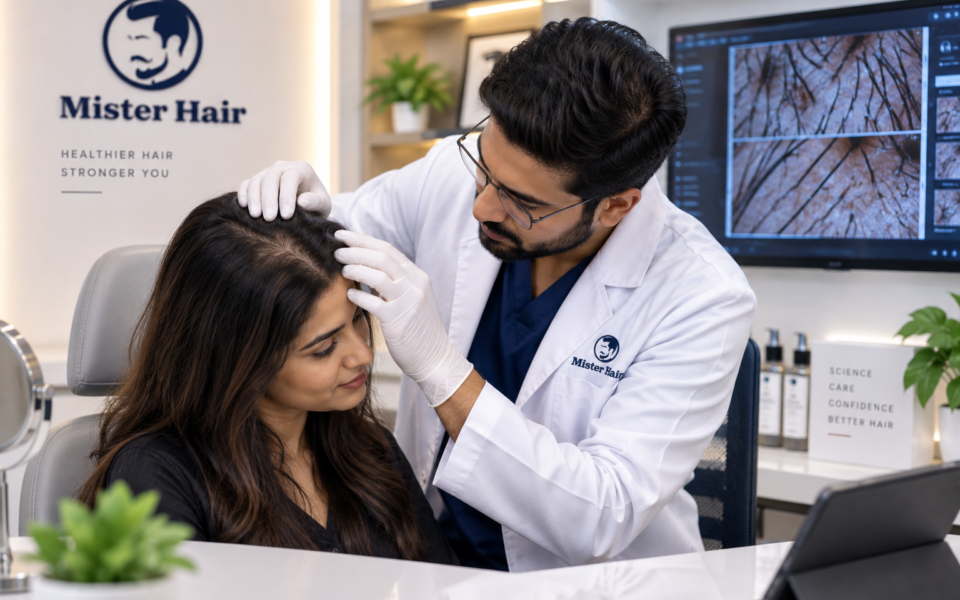
Can Women Get a Hair Transplant? A Guide to Female Hair Loss Treatment
Hair loss is often talked about as if it is mainly a men’s problem.
It isn’t.
Many women experience gradual thinning, a widening parting, reduced density around the crown or changes around the hairline. And because women often style their hair differently or have longer hair, even moderate thinning can become very noticeable.
One question that naturally comes up is:
Can women get a hair transplant?
Yes, some women can be suitable candidates for hair transplantation. But a transplant is not automatically the right treatment for every woman experiencing hair loss.
The important first step is understanding why the hair is thinning and whether enough healthy donor hair is available.
Can Women Get a Hair Transplant?
Yes. Hair transplantation can be an option for selected women with certain types of hair loss.
The suitability of a transplant depends on factors such as:
- The cause of hair loss
- The pattern and stability of thinning
- Donor hair density
- The condition of the scalp
- The area requiring restoration
- Expectations about the result
- Whether the underlying cause is being appropriately managed
This is why a proper diagnosis should come before deciding on surgery.
MisterHair’s female hair loss treatment service is designed around assessing female hair loss and available treatment options.
Why Do Women Lose Hair?
Female hair loss can have several possible causes.
Some women experience genetic or female-pattern hair loss, while others may notice shedding related to nutritional deficiencies, hormonal changes, illness, stress or scalp conditions.
Common patterns can include:
Diffuse thinning
Hair becomes thinner across a broader area rather than disappearing from one clearly defined bald patch.
Widening of the part
The centre parting may gradually become more visible.
Crown thinning
Density around the top or crown of the scalp may reduce.
Hairline changes
Some women experience thinning around the frontal hairline or temples.
These patterns can require very different treatment approaches.
Is Hair Transplant the First Treatment for Female Hair Loss?
Not always.
This is an important point.
If hair loss is caused by an underlying medical or scalp condition, treating that cause may be more appropriate than immediately considering transplantation.
A dermatologist or hair-restoration specialist may first evaluate:
- Hair density
- Hair shaft thickness
- Miniaturisation
- Scalp health
- Donor density
- Pattern of hair loss
- Possible contributing factors
Only after this assessment can a suitable treatment plan be considered.
When May a Woman Be a Candidate for Hair Transplantation?
A woman may be considered for hair transplantation when the hair loss pattern is appropriate and there is sufficient healthy donor hair.
For example, transplantation may be considered for selected women experiencing:
- Stable hairline thinning
- Localised hair loss
- Certain forms of female-pattern hair loss
- Hairline recession
- Density loss where donor hair is adequate
- Certain cases of hair loss after previous procedures or injury
However, diffuse thinning throughout the entire scalp can make transplantation more challenging because the available donor hair may also be limited.
Why Is Donor Hair Important?
A hair transplant does not create new hair follicles.
Instead, healthy follicles are moved from a donor area to areas where more coverage is needed.
This makes donor assessment extremely important.
The back and sides of the scalp may provide follicles that are more resistant to pattern hair loss, but the quality and density of the donor area vary between individuals.
MisterHair’s 8-Point Hair & Scalp Analysis assesses factors such as hair-loss grade, donor density, scalp condition and hair-shaft characteristics.
What Is a Female Hair Transplant Like?
When transplantation is appropriate, the general principle is similar to hair transplantation in men.
Individual follicular units are carefully harvested from the donor area and placed into planned recipient areas.
MisterHair currently offers DHI and Sapphire FUE hair transplantation. The clinic’s treatment page explains that DHI uses a specialised Choi implantation pen, while Sapphire FUE uses sapphire-tipped blades to create recipient sites.
The appropriate approach depends on the individual’s hair loss, donor area and treatment goals rather than simply choosing one technique because it is more popular.
DHI vs Sapphire FUE for Women
There isn’t one technique that is automatically best for every woman.
DHI Hair Transplant
DHI can provide precise control during implantation and may be considered for selected hairline or smaller-area restoration.
Sapphire FUE
Sapphire FUE may be considered when larger areas or denser placement are required.
The important question isn’t:
“Which technique is better?”
It is:
“Which technique is appropriate for my hair loss pattern and donor area?”
That answer should come from an individual assessment.
Can Women Have a Hairline Transplant?
Yes, selected women may undergo hairline restoration.
However, female hairlines can have different characteristics from male hairlines.
A natural-looking design should take into account:
- Facial proportions
- Existing hairline
- Hair direction
- Hair density
- Age
- Donor availability
- Future hair-loss pattern
The objective should be a natural transition rather than simply creating an artificially low hairline.
How Long Does a Female Hair Transplant Take to Show Results?
Hair transplantation requires patience.
The transplanted hairs can initially shed before entering a new growth cycle.
MisterHair’s current guidance states that transplanted hair may shed during the first few weeks, with new growth typically beginning around month three, visible improvement around month six and further maturation around month twelve. Individual timelines vary.
So, the appearance during the first few weeks should not be used to judge the final result.
What Happens During the First Consultation?
A proper consultation should be more than simply looking at the amount of hair you have lost.
The assessment should consider:
- Your hair-loss pattern
- Scalp condition
- Donor density
- Hair-shaft characteristics
- Existing miniaturised hairs
- Family history where relevant
- Previous treatments
- Your expectations
This is particularly important for women because diffuse thinning can sometimes make transplantation less suitable.
Can Female Hair Loss Be Treated Without a Hair Transplant?
Yes.
Depending on the cause, non-surgical approaches may be considered.
These can include medical treatment, scalp care, nutritional correction where appropriate, PRP or other regenerative approaches.
MisterHair also provides PRP hair treatment and other hair-loss treatment options.
The right treatment depends on the diagnosis rather than choosing a procedure first.
Frequently Asked Questions
Can women get hair transplants?
Yes. Selected women can be candidates for hair transplantation when the cause and pattern of hair loss are suitable and adequate donor hair is available.
Is female hair transplant different from male hair transplant?
The basic transplantation principle is similar, but female hair loss often has different patterns and requires careful assessment of diffuse thinning, hairline design and donor density.
Is hair transplant suitable for female pattern hair loss?
It can be suitable for selected patients, but the pattern and stability of hair loss and the donor area need to be assessed first.
Can women with thin hair have a hair transplant?
Possibly. The key factor is not simply whether the hair looks thin, but whether there is enough healthy donor hair and an appropriate recipient area.
Is DHI better than Sapphire FUE for women?
Neither is automatically better for every woman. The appropriate technique depends on the individual’s hair loss, donor area, treatment area and goals.
How long does female hair transplant recovery take?
Initial healing happens during the first several days to weeks, while visible hair growth takes several months. Full maturation can take around a year or longer in some patients.
Should women try non-surgical hair loss treatment first?
Depending on the cause, non-surgical treatment may be appropriate before considering transplantation. A proper diagnosis helps determine the right sequence.
Final Thoughts
A female hair transplant can be a valuable option for selected women, but it should never be treated as a one-size-fits-all solution.
The most important step is finding out why your hair is thinning and whether your donor area can support transplantation.
If you’re noticing progressive thinning, widening of the parting or changes around the hairline, getting a professional assessment early can help you understand your options.
MisterHair
Hair Restoration | DHI | Sapphire FUE | Hair Treatments | Exosomes
Call: 7338671338
Email: reachus@misterhair.in
Book Your Appointment