
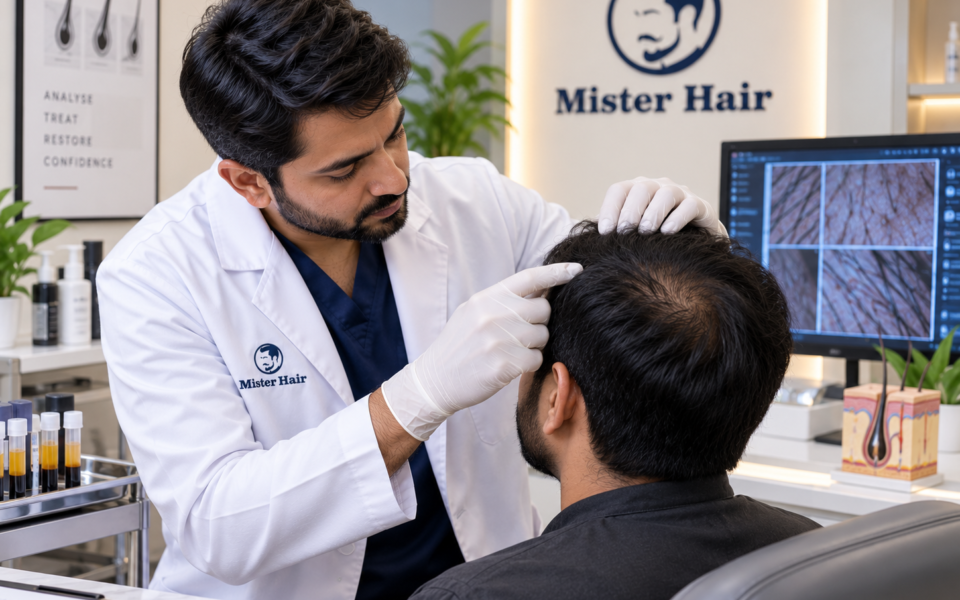
PRP Hair Treatment: How Many Sessions Do You Need and When Do Results Show?
Seeing more hair on your pillow, in the shower or on your comb can be unsettling.
And when you’re looking for a solution, you may come across PRP hair treatment quite often.
But then come the practical questions:
How many PRP sessions do I actually need?
When will I see results?
Does PRP work for everyone with hair loss?
These are much more useful questions than simply asking whether PRP is “good” or “bad.”
PRP can be a useful non-surgical option for selected people with early hair thinning and can also be used as part of a broader hair-restoration plan. But the response varies, and understanding what the treatment can realistically do is important.
What Is PRP Hair Treatment?
PRP stands for platelet-rich plasma.
During treatment, a small amount of your own blood is collected and processed to concentrate the platelets and growth-factor-rich plasma.
The concentrated plasma is then injected into selected areas of the scalp.
The goal is to support the environment around existing hair follicles and encourage healthier hair growth in suitable candidates.
MisterHair describes PRP as a doctor-led, non-surgical treatment that is commonly considered for early-stage thinning and hair-density support.
You can read more about PRP Hair Treatment at MisterHair.
Who May Benefit From PRP for Hair Loss?
PRP is generally more useful when hair follicles are still present but are producing thinner or weaker hair.
It may be considered for people experiencing:
- Early pattern hair loss
- Increased hair shedding
- Reduced hair density
- Early-stage thinning
- Some forms of diffuse thinning
- Hair-density maintenance
- Support following a hair transplant
It is not a replacement for a hair transplant in cases of advanced baldness, where follicles may no longer be active.
That distinction is important.
How Does PRP Work for Hair?
Hair follicles go through different stages of the hair-growth cycle.
In some types of hair loss, follicles gradually become smaller and produce finer hairs.
PRP delivers a concentrated preparation of your own platelets and associated growth factors into the scalp.
The intended goal is to support follicle activity and the surrounding scalp environment.
However, PRP isn’t a magic reset button.
The response depends on factors such as:
- Cause of hair loss
- Stage of hair loss
- Follicle health
- Age
- Overall health
- Hair-loss pattern
- Individual response to treatment
This is why diagnosis comes before treatment.
How Many PRP Hair Treatment Sessions Are Needed?
There isn’t one fixed number that is right for everyone.
MisterHair’s current PRP protocol states that treatment plans often begin with around 3–6 sessions, spaced a few weeks apart, followed by periodic maintenance depending on the patient’s condition and response.
Your dermatologist or hair-restoration specialist may recommend a different schedule depending on your situation.
A typical approach may look like:
Initial phase:
A series of treatment sessions over several weeks or months.
Assessment phase:
Your response is reviewed rather than assuming the same number of sessions will work for everyone.
Maintenance phase:
Some patients may benefit from periodic sessions to help maintain the improvement.
The exact schedule should be personalised.
When Will PRP Hair Treatment Results Start Showing?
This is where patience matters.
PRP does not usually produce an overnight change in hair density.
MisterHair notes that many patients may notice reduced shedding first, with improvements in density developing over approximately 3–6 months.
A general timeline may look like this:
| Period | What You May Notice |
|---|---|
| First few days | Mild tenderness or scalp sensitivity may occur |
| First few weeks | Usually too early to judge growth |
| 1–3 months | Changes in shedding may become noticeable in some patients |
| 3–6 months | Hair density may gradually improve in suitable candidates |
| 6+ months | Ongoing assessment and maintenance may be considered |
Your actual timeline can be different.
Does PRP Stop Hair Fall Immediately?
Not necessarily.
Hair loss is influenced by the underlying cause and the natural hair-growth cycle.
Some patients may notice reduced shedding before they notice visible improvement in density.
That is why taking monthly photographs under similar lighting can be more useful than checking your hair in the mirror every day.
What Happens During a PRP Session?
A typical session is relatively straightforward.
Step 1: Blood collection
A small amount of blood is drawn.
Step 2: Processing
The blood is placed in a centrifuge to separate and concentrate the platelet-rich plasma.
Step 3: Scalp preparation
The scalp is cleaned and prepared. A numbing option may be used for comfort.
Step 4: PRP injection
The prepared plasma is carefully injected into the areas being treated.
MisterHair states that a typical PRP session takes approximately 30–60 minutes, with most patients able to return to normal activities the same day.
Is PRP Hair Treatment Painful?
Most people experience some temporary discomfort from the injections.
You may notice:
- Mild stinging
- Pressure
- Tenderness
- Temporary sensitivity
The exact experience varies.
A numbing option can be used when appropriate to improve comfort.
Are There Side Effects From PRP?
Because PRP uses your own blood, allergic reactions to the injected material are uncommon.
Temporary effects may include:
- Mild tenderness
- Redness
- Minor swelling
- Sensitivity at injection sites
MisterHair notes that these effects are generally mild and temporary, but suitability should still be assessed by a doctor.
If you have a medical condition or take medications that could affect treatment, tell your doctor before starting.
PRP vs Hair Transplant: Are They the Same?
No.
They are very different treatments.
PRP
PRP is a non-surgical treatment intended to support existing hair follicles.
Hair Transplant
A hair transplant involves moving individual follicles from a donor area to areas where additional hair coverage is needed.
MisterHair currently provides DHI and Sapphire FUE hair transplantation, with the technique selected according to the patient’s hair loss, donor density and treatment goals.
In simple terms:
PRP supports existing follicles.
Hair transplantation redistributes follicles.
Can PRP Be Used After a Hair Transplant?
It can be included in some patients’ post-transplant care plans.
The purpose may be to support the surrounding native hair and the overall hair-restoration plan.
However, postoperative treatment should always follow your surgeon’s specific recommendations.
MisterHair’s current hair-transplant guidance notes that PRP or other regenerative sessions may be used as part of ongoing support following transplantation.
PRP vs Exosome Hair Treatment
PRP isn’t the only regenerative treatment available for hair loss.
MisterHair also offers MCT Exosome Hair Treatment.
However, these treatments should not be presented as interchangeable.
MCT exosome therapy is an evolving area, and MisterHair itself describes it as an emerging treatment where expectations should remain realistic.
The best choice depends on your hair-loss pattern, stage and treatment goals.
Why Is Hair and Scalp Analysis Important Before PRP?
Hair fall has many possible causes.
Before deciding on PRP, your specialist may assess:
- Hair density
- Scalp condition
- Hair-shaft thickness
- Pattern of thinning
- Donor area
- Degree of miniaturisation
- Existing treatment history
MisterHair’s 8-Point Hair & Scalp Analysis is designed to assess these factors before recommending a treatment plan.
This prevents a common mistake:
Choosing a treatment before understanding the reason for hair loss.
Can PRP Regrow Hair in a Completely Bald Area?
PRP is generally more useful when viable follicles are still present.
If an area has advanced baldness with little or no active follicular growth, PRP alone may not provide the coverage someone is looking for.
In such situations, a hair transplant or another treatment approach may need to be considered.
This is why realistic assessment is important.
Frequently Asked Questions
How many PRP sessions are needed for hair growth?
Many treatment plans begin with around 3–6 sessions, followed by maintenance when appropriate. The exact number depends on the patient’s hair loss and response.
How long does PRP take to show results?
PRP works gradually. Some people may notice changes in shedding earlier, while improvements in hair density may take around 3–6 months or longer.
Is PRP good for early hair loss?
PRP may be considered for selected patients with early-stage thinning, particularly when viable follicles are still present.
Can PRP regrow hair on a bald scalp?
PRP is not generally intended to recreate follicles in areas of advanced baldness. It is more useful when existing follicles can still respond.
Can PRP replace a hair transplant?
No. PRP and hair transplantation serve different purposes. PRP supports existing follicles, while transplantation moves follicles from a donor area to a recipient area.
How long does a PRP hair treatment session take?
A typical session at MisterHair takes around 30–60 minutes, although treatment time can vary.
Are PRP results permanent?
No. Hair-loss progression can continue, and maintenance treatment may be recommended for some patients.
Final Thoughts
PRP hair treatment can be a useful option for selected people dealing with early hair thinning, shedding or reduced density.
But the most important factor isn’t the number of injections.
It is whether the treatment matches the cause and stage of your hair loss.
If you’re noticing increased shedding or a gradual reduction in density, an assessment can help determine whether PRP, another non-surgical treatment or hair transplantation makes more sense for you.
MisterHair
Hair Restoration | DHI | Sapphire FUE | Hair Treatments | Exosomes
Call: 7338671338
Email: reachus@misterhair.in
Book Your Hair & Scalp Consultation
← Back to all articles