What Happens During a Hair Transplant Consultation?
If you’re considering a hair transplant, the first appointment shouldn’t be about convincing you to have surgery.
A proper hair transplant consultation is really about answering a much more basic question: Is a transplant actually suitable for your hair loss, and if it is, what would a sensible plan look like?
That means looking at your existing hair, the areas that are thinning, the strength of your donor area and, just as importantly, the possibility that your hair loss could continue in the future.
A good consultation gives you a clearer picture before you make a decision.
Why Is a Hair Transplant Consultation Important?
It’s easy to look at a receding hairline and immediately think, “I need 2,000 or 3,000 grafts.”
But graft numbers shouldn’t be decided from a photograph alone.
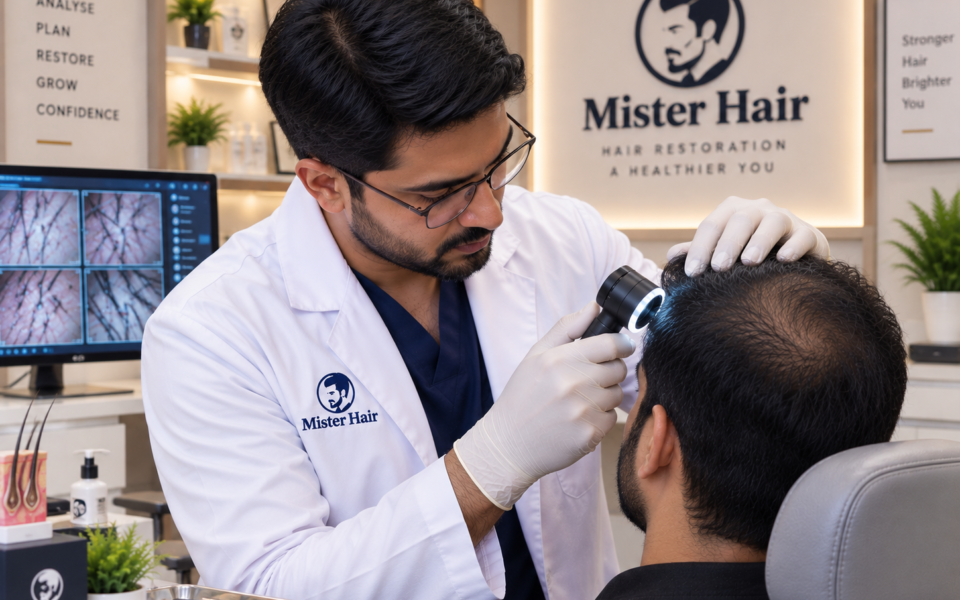
During a hair transplant consultation, a doctor needs to understand the pattern and extent of your hair loss, examine the scalp and assess whether you have enough suitable donor hair.
The American Academy of Dermatology similarly recommends a thorough scalp examination when assessing whether someone is a suitable candidate for transplantation.
That’s particularly important for younger patients, whose hair loss may still be changing.
What Does the Doctor Check First?
The consultation usually starts with a conversation.
You may be asked:
- When did you first notice thinning?
- Has the hair loss been getting worse?
- Does anyone in your family have significant hair loss?
- Have you tried medicines or other treatments?
- Have you recently experienced major stress, illness or weight loss?
- Are you noticing more hair shedding than usual?
- What bothers you most — the hairline, crown or overall density?
These questions aren’t just formalities.
For example, someone who suddenly started shedding heavily a few months after an illness may need a very different evaluation from someone who has slowly developed a receding hairline over several years.
The cause needs to be understood before deciding whether surgery makes sense.
Your Hairline Is Only One Part of the Assessment
Many people walk into a clinic focused entirely on their hairline.
The doctor has to look much further than that.
A hair transplant consultation should consider the overall pattern of loss, including:
- Frontal hairline
- Temples
- Mid-scalp
- Crown
- Existing hair density
- Miniaturised hairs
- Donor area
- Scalp condition
- Expected future hair loss
This broader view matters because transplanted hair may remain in the treated area while your existing, non-transplanted hair continues to thin.
The AAD also notes that hair-loss treatment may include medical management alongside transplantation because thinning can continue after a transplant.
Why Does the Donor Area Matter So Much?
Think of the donor area as your available supply of transplantable hair.
Usually, doctors assess the hair at the back and sides of the scalp because these areas may provide suitable grafts for restoration.
But having hair in the donor region doesn’t automatically mean that an unlimited number of grafts can be taken.
The doctor needs to consider:
- Density
- Hair calibre
- Distribution
- Stability
- Available grafts
- The amount needed for the recipient area
- Possible future procedures
MisterHair’s 8-Point Hair & Scalp Analysis specifically includes donor-area density as one of the assessment points.
That assessment can be particularly useful when someone is trying to decide whether a transplant is realistic.
Will the Doctor Count the Grafts During the Consultation?
A doctor may estimate the number of grafts required, but it shouldn’t be treated like a fixed number that applies to everyone.
For example, restoring a conservative hairline may require a different plan from rebuilding a larger frontal area and adding density to the crown.
The available donor hair also places practical limits on what can be done.
So if you see someone online saying, “Everyone needs exactly 3,000 grafts,” be cautious.
Your graft requirement should be based on your individual pattern and goals.
Will You Need a Blood Test?
Not everyone needs extensive testing.
If your history or examination suggests that a medical or nutritional factor may be contributing to your hair loss, the doctor may recommend appropriate blood tests.
The AAD notes that blood tests or, in selected cases, scalp biopsy may be used when a doctor suspects a disease, vitamin deficiency, hormonal imbalance or infection.
This is one reason a consultation shouldn’t focus only on surgery.
Sometimes the right first step is to investigate why the hair is thinning.
How Does the Doctor Decide Whether You’re a Candidate?
There isn’t one age at which everyone becomes a “good candidate.”
Instead, the doctor looks at the individual situation.
A suitable candidate generally needs enough healthy donor hair and an area where transplanted hair can reasonably be expected to grow.
The AAD identifies those two factors as important considerations when assessing hair-transplant candidacy.
The stability of your hair loss also matters.
If you’re very young and your hair loss is progressing rapidly, a doctor may recommend managing the hair loss first rather than immediately moving to surgery.
That’s not necessarily a rejection of transplantation. It can simply mean that timing matters.
What About DHI and Sapphire FUE?
Once the doctor understands your hair loss and donor area, different transplant techniques can be discussed.
MisterHair currently offers both DHI Hair Transplant and Sapphire FUE.
The choice isn’t simply about picking the technique with the most impressive-sounding name.
The doctor needs to consider factors such as:
- Area being restored
- Number of grafts required
- Hairline design
- Existing hair density
- Donor characteristics
- Your individual goals
A consultation is where those factors can be discussed properly.
What Should You Ask During Your Consultation?
Don’t be afraid to ask direct questions.
In fact, you should.
Here are a few worth asking:
How much hair loss do I currently have?
Ask the doctor to explain the pattern in simple terms.
How strong is my donor area?
This helps you understand how much restoration may realistically be possible.
Do I actually need a transplant now?
This is particularly important if you’re still experiencing active hair loss.
How many grafts are you recommending, and why?
You should understand the reasoning behind the estimate.
What happens to my existing hair?
A transplant doesn’t necessarily stop future native-hair loss.
What should I realistically expect?
Ask about density, timelines and limitations rather than only looking at before-and-after photographs.
Can You Have a Hair Transplant Without a Consultation?
Technically, clinics may advertise procedures online, but a responsible treatment plan still requires an individual assessment.
Photos can help with an initial discussion, but they cannot fully replace examining the scalp and donor area.
MisterHair’s current 8-Point Hair & Scalp Analysis is designed to evaluate hair-loss grade, donor density, scalp condition, hair-shaft characteristics, family history and relevant medical and lifestyle factors before recommending a treatment plan.
What Should You Bring to the Appointment?
You don’t need a complicated folder.
But a few things can help.
If you have previous:
- Blood reports
- Hair-loss treatment records
- Prescriptions
- Scalp photographs
- Previous consultation reports
bring them along.
It’s also useful to think about when your hair loss started.
If you have old photographs from one, two or three years ago, they can sometimes help show how quickly the pattern has changed.
What Happens After the Consultation?
Once the assessment is complete, the doctor should explain the available options.
Depending on your situation, that could mean:
- Monitoring the hair loss
- Medical treatment
- Non-surgical hair treatments
- PRP
- Hair transplant
- A combination of approaches
MisterHair also offers PRP Hair Treatment and Female Hair Loss Treatment for appropriate patients.
The important thing is that the treatment should follow the diagnosis, not the other way around.
A Hair Transplant Shouldn’t Be a Rushed Decision
Hair transplantation is a personal decision.
You may have seen impressive before-and-after photographs online and already have a technique in mind. That’s completely understandable.
But your own scalp may tell a different story.
Perhaps you need fewer grafts than you expected. Perhaps your donor area needs to be protected for future loss. Perhaps medical treatment should come first.
Or perhaps you’re a suitable candidate and can move ahead with a well-planned procedure.
A good hair transplant consultation should help you understand which situation applies to you.
Frequently Asked Questions
How long does a hair transplant consultation take?
The duration depends on the complexity of the assessment. MisterHair’s 8-point hair and scalp analysis currently takes about 30 minutes and includes scalp examination, measurements and discussion of treatment options.
How do I know if I’m suitable for a hair transplant?
A doctor needs to assess your hair-loss pattern, donor area and the condition of the recipient area. The AAD notes that adequate healthy donor hair and an area capable of growing transplanted hair are important considerations.
Do I need to decide on DHI or Sapphire FUE before my consultation?
No. It’s better to discuss your hair-loss pattern and goals first. The appropriate technique can then be considered based on your individual situation.
Can women have a hair transplant?
Yes, some women can be suitable candidates. However, female hair loss can have several causes, so diagnosis and assessment are particularly important before considering surgery. MisterHair provides dedicated Female Hair Loss Care.
Does a hair transplant stop future hair loss?
No. A transplant restores hair to selected areas, but existing non-transplanted hair can continue to thin. Ongoing hair-loss management may therefore be recommended.
Ready to Understand Your Hair Loss?
If you’re considering a transplant, start with an assessment rather than starting with a graft number.
MisterHair
Hair Restoration | DHI | Sapphire FUE | Hair Treatments
Call: 7338671338
Email: reachus@misterhair.in
Book Your Consultation