
Hair Loss Diagnosis: How Doctors Find the Real Cause
Hair loss can look simple from the outside, but the reason behind it isn’t always obvious. Hair loss diagnosis helps determine whether you’re dealing with hereditary thinning, temporary shedding, nutritional issues, scalp problems, hormonal changes, or another cause.
This matters because two people can experience similar hair fall but need completely different approaches.
Instead of immediately choosing a treatment because it worked for someone else, a proper assessment starts with a more important question: why is the hair loss happening?
The American Academy of Dermatology also emphasizes that identifying the cause is an important first step because different types of hair loss require different approaches.
Why Is Hair Loss Diagnosis Important?
Hair loss can happen for many reasons.
Common possibilities include:
- Hereditary or pattern hair loss
- Temporary shedding after illness or major stress
- Nutritional deficiencies
- Thyroid or hormonal changes
- Scalp inflammation or infection
- Tight hairstyles or repeated traction
- Certain medications
- Hair shaft damage and breakage
- Female-pattern hair loss
- Alopecia areata and other medical conditions
This is why simply counting the number of hairs falling during a shower doesn’t tell you what is actually happening.
A proper hair loss diagnosis looks at the pattern, duration, scalp condition, hair density, family history and other relevant factors.
At MisterHair, the assessment begins with an 8-Point Hair & Scalp Analysis, which is designed to look beyond the visible symptom of hair fall.
What Happens During a Hair Loss Assessment?
A good consultation should feel more like an investigation than a sales conversation.
Your doctor may start by asking questions such as:
- When did you first notice hair loss?
- Is the shedding sudden or gradual?
- Are you losing hair from the hairline, crown or overall scalp?
- Does hair loss run in your family?
- Have you recently experienced significant stress or illness?
- Have there been changes in your diet or weight?
- Are you taking any medications?
- Have you recently had hormonal changes?
- Do you have itching, scaling or inflammation on your scalp?
These details can help narrow down possible causes.
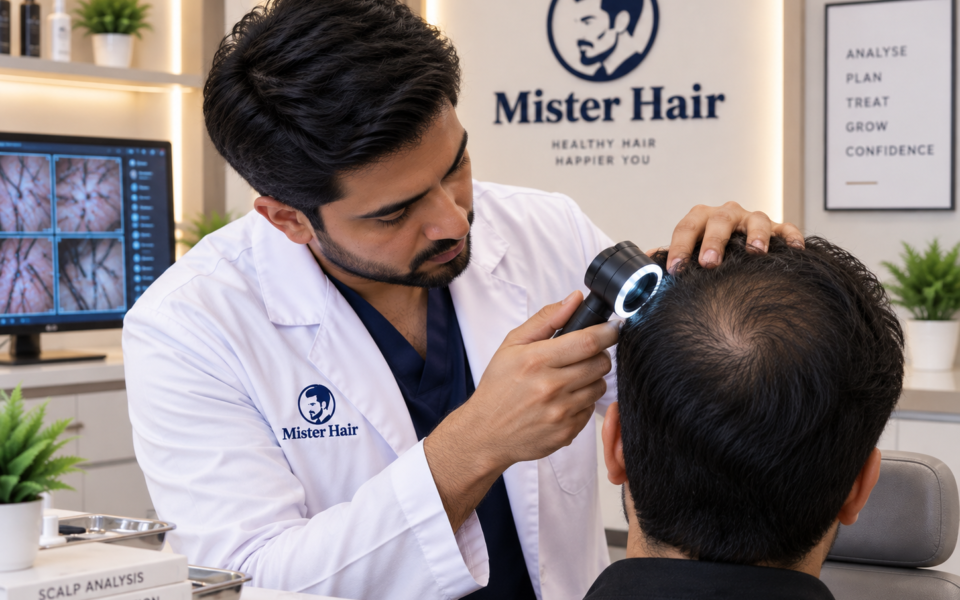
The doctor then examines the scalp and hair itself.
The American Academy of Dermatology notes that dermatologists may examine the scalp, assess hair health and, when indicated, recommend blood tests or other investigations to help identify the underlying cause.
Can a Scalp Examination Show Why Hair Is Falling?
Often, the scalp provides important clues.
A doctor may look for:
- Reduced hair density
- Miniaturised hairs
- Differences between hair follicles
- Scalp inflammation
- Excessive oiliness or flaking
- Signs of infection
- Broken hairs
- Receding hairline
- Widening parting
- Patchy areas of hair loss
This examination is particularly useful because hair loss isn’t always uniform.
For example, hereditary male-pattern hair loss commonly affects the hairline and crown, while female-pattern hair loss may present more as overall thinning or a widening part.
What Is Trichoscopy?
Trichoscopy is a magnified examination of the scalp and hair.
Instead of relying only on what can be seen with the naked eye, the doctor can examine hair shafts and follicular patterns more closely.
It can help assess things such as:
- Hair shaft thickness
- Miniaturisation
- Density
- Follicular patterns
- Scalp changes
- Differences between affected and unaffected areas
This can make the hair loss diagnosis more detailed than a simple visual examination.
At MisterHair, trichoscopy and scalp examination form part of the broader diagnostic approach used to understand the patient’s hair-loss pattern.
Does Everyone With Hair Loss Need Blood Tests?
No.
Blood tests aren’t automatically necessary for everyone experiencing hair loss.
They may be considered when the medical history or examination suggests a possible nutritional, hormonal, thyroid or other systemic factor.
For example, depending on the case, a doctor may consider tests related to:
- Iron or ferritin
- Thyroid function
- Vitamin D
- Vitamin B12
- Hormonal factors
- Other relevant nutritional or medical markers
The important point is that testing should be guided by the individual case rather than ordering every possible test without a reason.
Hair Shedding and Hair Loss Are Not Always the Same
This is an important distinction.
Some people notice significantly more hair coming out during washing or combing but don’t necessarily have permanent follicular loss.
Temporary shedding can happen after:
- A significant illness
- High fever
- Major stress
- Surgery
- Rapid weight loss
- Pregnancy or childbirth
- Certain medications
The American Academy of Dermatology distinguishes excessive shedding from hair loss and notes that some causes can resolve once the underlying trigger is addressed.
That’s another reason hair loss diagnosis should come before deciding on a long-term treatment.
When Should You Consider a Hair Loss Diagnosis?
Consider getting your hair assessed if you notice:
1. A receding hairline
If your temples appear to be moving backward gradually, it may be worth evaluating whether you are developing a pattern of hair loss.
2. A widening crown
A thinning crown can be easy to miss initially, especially when looking at yourself from the front.
3. Increasing hair shedding
If your shedding has noticeably increased and continues rather than settling, an assessment can help identify possible triggers.
4. A widening centre part
For women, a widening part can be one of the early visible signs of female-pattern hair loss.
5. Patchy hair loss
Sudden round or irregular bald patches should be evaluated rather than treated as ordinary hair fall.
6. Scalp symptoms
Persistent itching, scaling, inflammation or discomfort alongside hair loss deserves medical attention.
Does Hair Loss Diagnosis Mean You Need a Hair Transplant?
No.
This is one of the most important things to understand.
A hair loss diagnosis does not automatically lead to surgery.
Depending on the cause, the recommended approach could involve:
- Medical treatment
- Lifestyle or hair-care changes
- Treating an underlying condition
- PRP
- Other non-surgical options
- Monitoring without immediate treatment
- Hair transplant in suitable candidates
The American Academy of Dermatology notes that not everyone with hair loss needs the same treatment, and sometimes treatment may not be necessary if the hair is expected to regrow naturally.
If a transplant is appropriate, the Hair Transplant team can assess donor availability and the areas requiring restoration.
Why Donor Area Assessment Matters
For someone considering a transplant, understanding the donor area is particularly important.
The donor region is generally located at the back and sides of the scalp.
During an assessment, the doctor may evaluate:
- Donor density
- Hair quality
- Available grafts
- Stability of the donor area
- Degree of existing hair loss
- Expected future progression
This helps determine whether a transplant is appropriate and how restoration could be planned.
A transplant should be considered only after understanding the overall hair-loss pattern rather than treating one visibly thin area in isolation.
Can Hair Loss Be Treated Without Surgery?
In many cases, yes.
The treatment depends entirely on the diagnosis.
For example, a person with temporary shedding may need a very different approach from someone with progressive hereditary hair loss.
MisterHair also offers PRP Hair Treatment and dedicated Female Hair Loss Treatment for appropriate cases.
The goal should be to match the treatment to the cause rather than automatically choosing the most intensive option.
Why a Personalised Assessment Matters
Search online for “hair loss treatment” and you’ll find dozens of recommendations.
The problem is that your hair loss may not be the same as someone else’s.
A treatment that makes sense for hereditary thinning may not address hair shedding caused by a temporary trigger.
Similarly, someone with a healthy donor area and stable pattern hair loss may be evaluated differently from someone whose hair loss is still progressing.
That’s why a structured hair loss diagnosis can save time, reduce unnecessary treatments and provide a clearer starting point.
What Makes a Good Hair Loss Consultation?
A useful consultation should answer four basic questions:
1. What type of hair loss do I have?
Understanding the pattern is the foundation.
2. What could be causing it?
The doctor should discuss relevant possible causes rather than assuming everything is genetic.
3. What treatment options are appropriate?
Treatment should be based on the diagnosis.
4. What should I realistically expect?
Hair growth takes time, and different treatments have different timelines.
MisterHair’s 8-Point Hair & Scalp Analysis covers hair-loss grade, donor density, scalp condition, hair shaft characteristics, family history and relevant medical and lifestyle factors.
Frequently Asked Questions
What is hair loss diagnosis?
Hair loss diagnosis is the process of identifying the type and possible cause of hair loss through medical history, scalp and hair examination and, when appropriate, additional tests.
How do doctors diagnose hair loss?
Doctors usually begin with your history and examine the scalp and hair. Magnified scalp examination such as trichoscopy may provide additional information. Blood tests or other investigations may be recommended when medically appropriate.
Is hair loss always caused by genetics?
No. Hereditary hair loss is common, but hair shedding can also be associated with illness, stress, nutritional factors, hormonal changes, scalp conditions, medications and other causes.
Does hair loss diagnosis mean I need a transplant?
No. Diagnosis comes first. Depending on the cause, treatment may involve medical management, non-surgical treatments, monitoring or, in suitable cases, a hair transplant.
How long does a hair loss assessment take?
The duration depends on the type of assessment. MisterHair’s 8-point analysis is described as taking approximately 30 minutes and includes scalp examination, measurements and discussion of treatment options.
When should I see a doctor about hair loss?
If hair loss is persistent, rapidly increasing, patchy, associated with scalp symptoms or causing noticeable thinning, a professional assessment can help identify the cause.
Final Takeaway
Hair loss isn’t one condition with one solution.
The first useful step is understanding what type of hair loss you have and why it is happening. A structured hair loss diagnosis can help separate temporary shedding from progressive thinning and determine whether you need treatment at all.
If you’re noticing increasing hair fall or thinning, consider starting with an assessment rather than choosing a treatment based only on what you see online.
MisterHair
Hair Restoration | DHI | Sapphire FUE | Hair Treatments
Call: 7338671338
Email: reachus@misterhair.in
Book a consultation