Hair Transplant Density: What Determines How Full Your Hair Looks?
When people research hair transplantation, the number of grafts is often the first thing they ask about. But graft count alone does not determine how full the transplanted area will look. Hair transplant density depends on several factors, including the number of available donor follicles, the thickness of the patient’s hair, the size of the treatment area, existing native hair and how the grafts are planned and placed.
Two people receiving the same number of grafts can therefore have noticeably different visual results.
A good hair-transplant plan focuses on using the available donor hair thoughtfully rather than simply trying to maximise the number of grafts.
Understanding hair density and graft density
Hair density refers to how much hair is present within a particular area of the scalp. Graft density refers more specifically to how follicular units are distributed within the transplanted area.
A follicular unit may contain one, two, three or more individual hairs. This means that counting grafts alone does not tell you exactly how many hairs will ultimately be present.
For example, 2,000 grafts containing predominantly two-hair follicular units will produce a different total hair count from 2,000 grafts containing a greater proportion of three- or four-hair units.
This is one reason an experienced assessment should look at the donor area’s characteristics rather than treating every graft as identical.
MisterHair provides Hair Transplant treatment using techniques such as DHI and Sapphire FUE, with treatment planning based on individual hair-loss characteristics.
The donor area sets an important limit
The donor area is the source of follicles used for transplantation.
Most scalp transplants use follicles from the back and sides of the scalp. However, the amount of usable donor hair varies considerably between individuals.
Some people naturally have:
- High donor density
- Thick hair shafts
- Multiple-hair follicular units
- Good scalp coverage
Others may have:
- Lower donor density
- Fine hair
- Diffuse thinning
- Limited available follicles
Because donor hair is limited, the treatment plan has to balance current restoration with possible future needs.
Using too much donor hair in one area may leave fewer options if additional thinning develops later.
Hair thickness changes the visual appearance of density
Hair shaft thickness is another important factor.
Thicker hair can provide greater visual coverage because each individual hair occupies more visible space.
Fine hair may require different planning because more scalp can remain visible between individual hairs.
This does not mean that people with fine hair cannot achieve useful improvement. It simply means that expectations and graft planning should account for the characteristics of the patient’s existing hair.
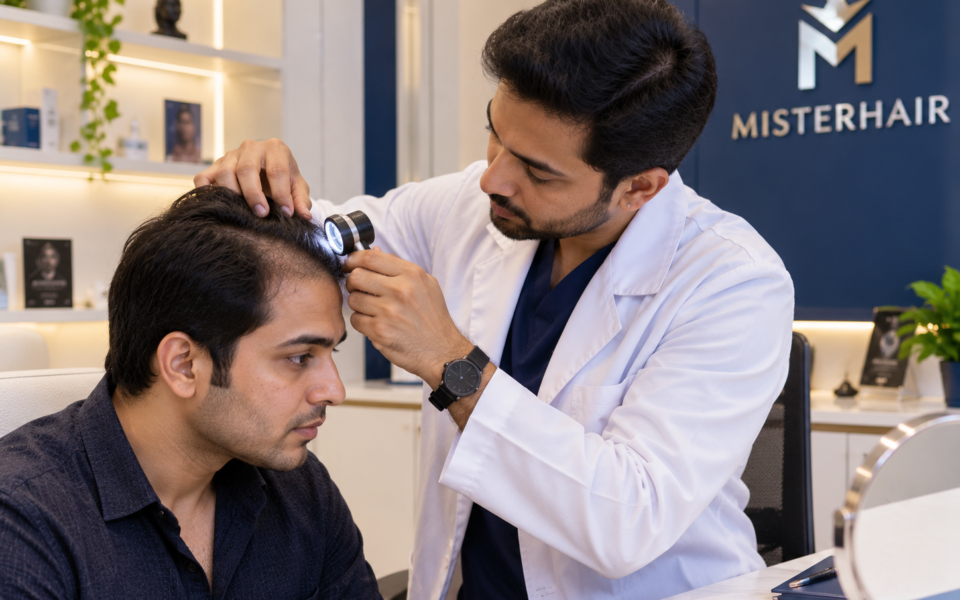
MisterHair’s 8-Point Hair & Scalp Analysis includes assessment of hair-shaft thickness and miniaturisation as part of the overall evaluation.
Existing hair can influence the final appearance
Hair transplantation does not always involve an entirely bald area.
Many patients have a combination of transplanted follicles and existing native hair.
For example, someone with frontal thinning may still have hundreds of miniaturising hairs in the area.
Rather than simply filling the entire region with new grafts, the doctor needs to consider the existing hair and how it may change over time.
This is particularly important when the hair loss is still progressing.
The AAD notes that hair loss can continue after a transplant because non-transplanted hair may continue to thin. This is one reason long-term planning matters when considering transplantation.
Density needs to match the treatment area
The size of the area being treated has a major effect on the final density.
Suppose the same number of grafts is used in two different patients.
If the first patient has a small area of temple recession, those grafts can be concentrated within a relatively limited area.
If the second patient has extensive frontal and crown thinning, the same number of grafts must cover a much larger region.
The visible density will therefore be different.
This is why asking only, “How many grafts will I get?” does not provide the complete picture.
The more useful question is how the available grafts will be distributed across the areas that need restoration.
Hairline density requires careful planning
The frontal hairline is one of the most visible areas of a transplant.
A natural hairline should transition gradually rather than appearing like a dense straight wall of hair.
The first part of the hairline may use finer follicular units, with density increasing behind the frontal edge.
The doctor also considers:
- Hair direction
- Hair angle
- Existing hair
- Temple shape
- Facial proportions
- Age
- Future hair loss
The goal is not simply to create maximum density at the front. It is to create a hairline that fits the patient’s overall appearance.
DHI and Sapphire FUE do not automatically determine density
DHI and Sapphire FUE are different hair-transplant techniques, but neither should be viewed as a guarantee of a particular density.
The density that can be achieved depends on the patient’s donor supply, hair characteristics, treatment area and overall plan.
MisterHair’s DHI and Sapphire FUE hair transplant service explains that technique selection depends on individual factors such as hair grade, density and restoration requirements.
The procedure should therefore be selected after assessment rather than choosing a technique simply because it is marketed as producing higher density.
High density is not always the right objective
A common assumption is that more density automatically means a better transplant.
In reality, the doctor has to work within the patient’s donor limitations.
A very aggressive restoration may use a large proportion of available donor follicles for one area. That can create difficulties if the patient later needs additional restoration elsewhere.
Long-term planning is therefore particularly important for younger patients or people whose hair loss is still developing.
The objective is to create an appropriate balance between:
Coverage + natural appearance + donor conservation + future planning.
Graft placement matters
The way grafts are distributed also affects the appearance of density.
The doctor needs to consider the direction in which existing hair grows and the transition between different areas.
Random placement can make transplanted hair look less integrated with the surrounding hair.
Careful placement allows the new follicles to follow the natural growth pattern as closely as possible.
This is especially important around the frontal hairline and areas where transplanted and native hair meet.
Scalp characteristics can affect the visible result
The amount of scalp that can be seen between hairs depends partly on the patient’s skin and hair characteristics.
People with very fine hair may see more scalp between individual strands.
Similarly, people with very short hairstyles may notice differences in density more easily than someone who keeps longer hair.
This is why transplant planning should be individual rather than based on a single standard density target.
Hair loss progression must be considered
One of the biggest mistakes in transplant planning is looking only at today’s bald or thinning area.
Hair loss may continue to affect untreated areas.
For this reason, the doctor should evaluate the pattern of existing loss and possible future progression.
A long-term plan may involve non-surgical hair-loss treatment alongside transplantation when medically appropriate.
MisterHair also provides PRP Hair Treatment as one of its non-surgical hair-treatment options.
The appropriate approach depends on the underlying cause and individual assessment.
How the consultation helps determine density
Before deciding on graft numbers, a proper consultation should establish:
- Current hair-loss pattern
- Donor density
- Hair calibre
- Miniaturisation
- Scalp condition
- Treatment area
- Existing native hair
- Future hair-loss considerations
- Patient expectations
MisterHair’s 8-Point Hair & Scalp Analysis is designed to assess these factors and determine whether surgical, non-surgical or no treatment is appropriate.
This makes the consultation an important part of the treatment rather than simply a step before booking surgery.
What patients should realistically expect
A hair transplant should not be approached with the expectation that it will recreate the exact density of naturally thick teenage hair.
The achievable result depends on the starting point.
A person with substantial donor density and a smaller treatment area may have different possibilities from someone with extensive loss and limited donor supply.
The most useful goal is an improvement that looks natural and is planned around the patient’s available resources.
Frequently Asked Questions
What determines hair transplant density?
Donor density, hair thickness, follicular-unit characteristics, treatment area, existing hair and graft placement all influence the final appearance.
Does more grafts always mean more density?
No. Graft count needs to be considered alongside the size of the treatment area and the characteristics of the grafts.
Can thin hair achieve good transplant coverage?
Thin hair can be transplanted, but the planning and expected visual coverage need to account for the hair calibre.
How is donor density assessed?
A consultation can evaluate the number and characteristics of available follicles in the donor area.
Does existing hair affect transplant planning?
Yes. Existing native hair and its potential future thinning need to be considered when planning graft placement.
Can hair density increase after a transplant?
The transplanted hairs initially go through a growth cycle, and visible improvement develops gradually as new hair growth occurs.
Is high-density hair transplantation suitable for everyone?
No. The appropriate density depends on donor availability, treatment area, hair characteristics and long-term planning.
Hair Transplant Planning at MisterHair
A successful hair restoration plan starts with understanding the patient’s existing hair rather than focusing on a single graft number.
At MisterHair, the consultation evaluates the hair-loss pattern, donor area, hair characteristics and restoration goals before determining the appropriate treatment approach.
MisterHair
Hair Restoration | DHI | Sapphire FUE | Hair Treatments
Call: 7338671338
Email: reachus@misterhair.in
Bangalore: Sadashivanagar | RR Nagar | Jayanagar | HSR | HRBR | Bannerghatta
← Back to all articles