
Hair Transplant Donor Area: What Makes It Suitable?
When people start researching a hair transplant, most of the attention goes to the bald or thinning area.
How many grafts are needed?
What will the hairline look like?
Should you choose DHI or Sapphire FUE?
But there is another part of the scalp that is just as important: the hair transplant donor area.
The donor area is where follicles may be taken from during a hair transplant and moved to areas affected by thinning or baldness.
If the donor area has good density and suitable hair characteristics, it can provide more options for restoration. If donor supply is limited, the treatment plan needs to be much more carefully planned.
That is why a proper hair transplant donor area assessment should happen before deciding how many grafts you need.
What Is the Donor Area in a Hair Transplant?
The donor area generally refers to the hair-bearing areas of the scalp from which follicles can be harvested for transplantation.
In many hair-restoration procedures, this includes hair around the back and sides of the scalp.
The follicles are then transferred to areas where additional coverage is required.
A hair transplant therefore works with the patient’s existing supply of hair.
It does not create an unlimited number of new follicles.
The American Academy of Dermatology explains that suitable hair-transplant candidates need enough healthy hair that can be transplanted and an area of the scalp capable of growing the transplanted hair. A dermatologist evaluates these factors during the consultation.
Why Is the Hair Transplant Donor Area So Important?
Imagine having a large area of thinning but only a small amount of suitable donor hair.
In that situation, simply requesting a very high graft number may not be realistic.
A responsible treatment plan needs to balance:
- Existing donor density
- Area requiring coverage
- Hair characteristics
- Pattern of hair loss
- Future hair-loss risk
- Patient expectations
- Available graft supply
This is why donor area assessment is one of the important parts of hair-transplant planning.
MisterHair’s current 8-point Hair & Scalp Analysis specifically assesses donor-area density and estimates how many grafts may be available if transplantation is appropriate.
Learn more about MisterHair’s 8-Point Hair & Scalp Analysis
What Makes a Good Hair Transplant Donor Area?
There isn’t one single measurement that determines whether a donor area is “good.”
Doctors generally consider several characteristics together.
1. Hair Density
The number of follicles available in the donor region matters.
A denser donor area can potentially provide more follicles for transplantation than an area with significantly reduced density.
However, density is only one part of the assessment.
2. Hair Thickness
Two people may have similar follicle counts but very different visual coverage.
Thicker hair shafts can provide more visual coverage than very fine hair.
Therefore, a hair transplant donor area assessment should consider not only how many hairs are present but also their calibre.
3. Distribution of Hair
Hair should be assessed across different parts of the donor region rather than judging one small patch.
The doctor may examine the back and sides of the scalp and compare density between areas.
This helps with planning where follicles can potentially be harvested.
4. Pattern of Existing Hair Loss
The doctor also needs to understand how the patient’s hair loss is progressing.
This matters because the donor area itself can sometimes be affected by hair thinning.
A donor area that appears dense today still needs to be evaluated in the context of the patient’s overall hair-loss pattern.
How Is Donor Density Measured?
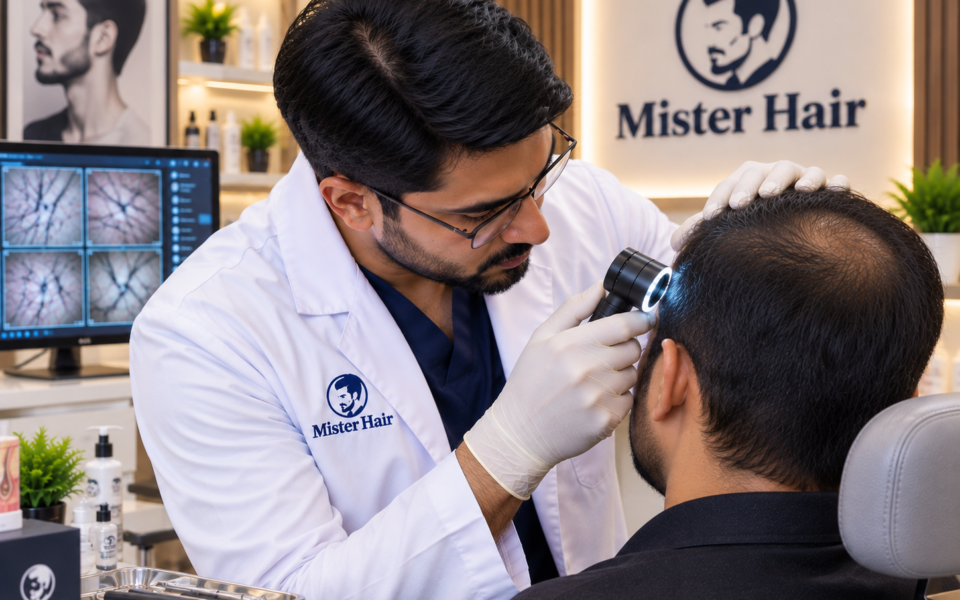
During a professional consultation, the scalp can be examined visually and with magnification or trichoscopy.
This can help the specialist assess:
- Hair density
- Hair shaft thickness
- Miniaturisation
- Scalp condition
- Differences between regions
- Potential donor supply
MisterHair’s 8-point assessment includes hair-loss grading, donor density, scalp condition and hair-shaft analysis as part of the consultation.
The purpose is not simply to give a number.
It is to understand what that number means for the individual’s overall hair-restoration plan.
Does a High Donor Density Mean You Can Get Unlimited Grafts?
No.
This is one of the most important things to understand.
Even if the donor area looks dense, doctors still need to consider how many follicles can reasonably be harvested while maintaining a natural appearance.
Overharvesting can make the donor area look visibly thinner.
Therefore, graft planning should balance the recipient area and donor area, rather than focusing only on the maximum possible graft count.
What Happens If the Donor Area Has Low Density?
Low donor density does not automatically mean that nothing can be done.
It means the treatment plan may need to be more conservative.
Depending on the situation, the doctor may discuss:
- Medical treatment
- Non-surgical hair-loss management
- A smaller transplant
- Prioritising the frontal region
- Improving existing hair density
- Monitoring future hair loss
- Other treatment options
The AAD notes that hair-transplant candidacy depends on having enough healthy hair available for transplantation and a suitable recipient area.
This is why a consultation is more useful than choosing a graft number based only on photographs.
Can the Donor Area Be Used More Than Once?
In some cases, additional harvesting may be possible, but this depends on the individual’s donor supply and previous harvesting.
The doctor must consider how much hair has already been removed and how much remains safely available.
This is particularly important for younger patients who may experience additional hair loss in the future.
A good plan therefore considers not only today’s baldness but also the possibility of future thinning.
Does the Donor Area Affect the Hairline Design?
Yes.
Hairline design and graft availability are connected.
A very low or aggressively designed hairline may require more grafts.
If the donor supply is limited, the doctor may need to design a hairline that provides appropriate coverage while preserving grafts for future needs.
This is one reason hairline design should be based on facial proportions, age, hair characteristics, donor supply and expected future hair loss rather than simply copying another person’s hairline.
DHI vs Sapphire FUE: Does the Donor Area Matter?
Yes.
The donor area needs to be assessed regardless of which transplant technique is being considered.
MisterHair currently offers DHI and Sapphire FUE hair-transplant procedures, with the treatment approach selected according to the patient’s hair-loss pattern and treatment requirements.
The important point is that technique selection comes after assessment.
It should not replace the assessment.
Read more about Hair Transplant at MisterHair
Can Hair Transplantation Make the Donor Area Look Thin?
The donor area can appear thinner if too many follicles are removed from a particular region.
This is why extraction planning matters.
The aim is to remove appropriate follicles while maintaining a natural appearance in the donor region.
The exact approach depends on factors such as density, hair characteristics, harvesting pattern and the amount of hair required.
This is another reason why asking only, “How many grafts can you give me?” is not enough.
A better question is:
How many grafts can be harvested while preserving the donor area’s appearance and planning for future hair loss?
What If My Hair Loss Is Still Progressing?
This is particularly important for younger patients.
A hair transplant moves existing follicles, but it does not stop other untreated hair from becoming thinner.
The AAD notes that hair loss can continue after transplantation and that medication may sometimes be recommended to slow further thinning and help maintain the overall result.
That is why stabilising or managing ongoing hair loss may form part of the overall treatment strategy.
What Should You Ask During a Donor Area Consultation?
If you are considering a hair transplant, ask your doctor:
- How dense is my donor area?
- How many grafts may realistically be available?
- Is my donor area likely to remain stable?
- Which areas should be prioritised?
- How should future hair loss be considered?
- What happens if I need another procedure later?
- Which transplant technique is appropriate for my case?
- What density can realistically be achieved?
These questions can give you a much clearer picture than focusing on a single graft number.
Hair Transplant Donor Area Assessment at MisterHair
At MisterHair, donor density is included in the clinic’s 8-point Hair & Scalp Analysis.
The assessment also considers:
- Hair-loss grade
- Donor density
- Scalp condition
- Hair shaft thickness
- Miniaturisation
- Family history
- Medical and nutritional factors
- Lifestyle
- Treatment recommendation
MisterHair states that the assessment takes approximately 30 minutes and that the recommendation may be surgical, non-surgical or no treatment if treatment is not needed.
Book an 8-Point Hair & Scalp Analysis
Frequently Asked Questions
What is the hair transplant donor area?
The donor area is the part of the scalp from which hair follicles may be harvested for transplantation to areas affected by thinning or baldness.
Where is the donor area located?
It is commonly found around the back and sides of the scalp, although the suitability of each area needs to be assessed individually.
How is donor density checked?
A specialist can examine the scalp and use magnification or trichoscopy to assess density, hair calibre, miniaturisation and scalp condition.
Can everyone with hair loss have a hair transplant?
No. Suitability depends on factors including donor supply, the recipient area, the pattern of hair loss and overall scalp health.
Can a low-density donor area be transplanted?
It may still be possible in selected cases, but the treatment plan may need to be more conservative and expectations should be discussed realistically.
Can donor hair grow back after extraction?
The harvested follicle itself does not remain in the donor area after extraction. Therefore, harvesting must be carefully planned to avoid excessive depletion of the donor region.
Does donor density affect the number of grafts?
Yes. Donor density is one of the factors considered when estimating how many grafts may be available for transplantation.
Is donor assessment necessary before DHI or Sapphire FUE?
Yes. The donor area needs to be evaluated regardless of the transplant technique being considered.
Planning a Hair Transplant? Start With Your Donor Area
If you are considering a hair transplant, don’t start by choosing a graft number.
Start by understanding your hair transplant donor area.
A detailed assessment can help determine your donor density, hair characteristics, pattern of hair loss and realistic treatment options.
MisterHair
Hair Restoration | DHI | Sapphire FUE | Hair Treatments
Call: 7338671338
Email: reachus@misterhair.in
Bangalore: Sadashivanagar | RR Nagar | HRBR Layout | HSR Layout | Bannerghatta