
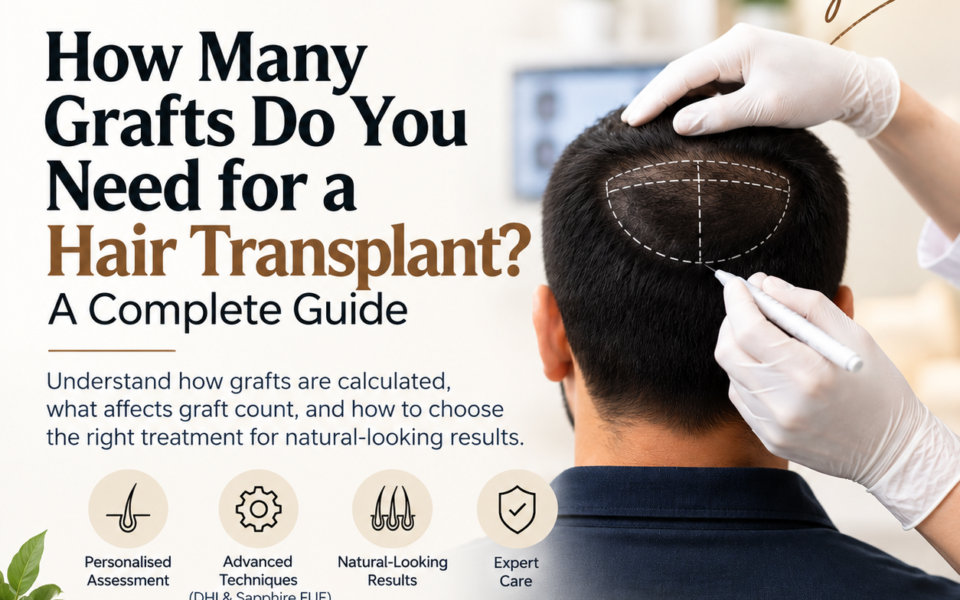
How Many Grafts Do You Need for a Hair Transplant? A Complete Guide
If you’ve started researching hair transplants, you’ve probably come across numbers like 2,000 grafts, 3,000 grafts or even 4,000 grafts.
And naturally, you may be wondering:
“How many grafts do I actually need?”
It’s a very common question. But there isn’t one number that works for everyone.
One person may need only 1,500 grafts to rebuild a receding hairline, while another person with more extensive hair loss may need 3,000 or more.
The number depends on your hair-loss pattern, the amount of coverage you need, your donor hair and the kind of result you’re hoping to achieve.
So before deciding on a number, it’s worth understanding what a graft actually means and how doctors estimate the requirement.
What Exactly Is a Hair Transplant Graft?
A graft is a small unit of tissue containing hair follicles.
During a hair transplant, healthy follicles are taken from a suitable donor area, usually at the back or sides of the scalp, and carefully placed into areas where hair has become thin or has been lost.
A graft doesn’t necessarily contain just one hair.
Some grafts contain a single hair, while others can contain two, three or more hairs.
That’s why 2,000 grafts doesn’t necessarily mean 2,000 hairs.
The number of hairs contained within those grafts also matters when planning how much coverage can be achieved.
So, How Many Grafts Do You Need?
This is where things become personal.
As a general guide, you might see approximate requirements such as:
1,000–1,500 grafts: Smaller hairline or temple correction
1,500–2,500 grafts: Hairline and frontal thinning
2,000–3,500 grafts: Frontal and mid-scalp coverage
3,000–4,500+ grafts: More extensive areas of hair loss
These aren’t fixed rules.
For example, two people with similar-looking hair loss may need different numbers of grafts because their hair thickness, donor density and desired density can be completely different.
That’s why an online graft calculator or a quick estimate from a photograph shouldn’t be treated as a final treatment plan.
What Determines Your Graft Requirement?
There are several things a hair-restoration specialist looks at before estimating grafts.
The Area Where You’ve Lost Hair
This is probably the most obvious factor.
If your main concern is a receding hairline, you may need fewer grafts than someone who has significant thinning across the frontal scalp, mid-scalp and crown.
The larger the area, the more grafts may be required.
But simply covering a large area isn’t the whole story. The density you want also matters.
Your Donor Hair
This is one of the most important parts of the assessment.
The hair at the back and sides of your scalp acts as your donor supply.
If you have good donor density, there may be more follicles available for transplantation.
If the donor area is already thin, the treatment needs to be planned more carefully.
A good hair transplant isn’t just about asking how much hair you’ve lost.
It’s also about asking:
“How much healthy donor hair do we have to work with?”
Your Existing Hair Thickness
Hair thickness can make a big difference to how dense the transplanted area looks.
Someone with thicker hair may achieve good visual coverage with fewer grafts than someone with very fine hair.
This is one reason why graft numbers shouldn’t be compared between people as though they are identical.
Your Hairline Design
A hairline isn’t simply a straight line drawn across the forehead.
It needs to look natural and should suit your face, age and existing hair pattern.
A very low hairline may look attractive initially, but it can use a significant amount of donor hair.
A carefully designed hairline takes both today’s appearance and future hair loss into account.
Is More Graft Count Always Better?
Not at all.
This is something many people don’t realise when they first start researching hair transplantation.
It can be tempting to think:
“If 3,000 grafts are good, then 4,000 must be better.”
But your donor hair is limited.
Using more grafts than necessary may not give you a better-looking result and could reduce the donor hair available if you need treatment again in the future.
The focus should be on using the available grafts intelligently.
The right question isn’t:
“How many grafts can you transplant?”
It’s:
“How many grafts do I need for a natural result?”
Is 2,000 Grafts Enough?
For some people, yes.
A 2,000-graft hair transplant may be enough to address areas such as:
A receding hairline
Temple recession
Frontal thinning
A smaller area of hair loss
But if someone has extensive baldness across the front, middle and crown, 2,000 grafts may not be enough to provide the desired coverage.
The location of the grafts matters just as much as the number.
What About 3,000 Grafts?
A 3,000-graft procedure can provide broader coverage for some patients.
Depending on the individual’s pattern of hair loss, grafts may be distributed between the hairline, frontal scalp, mid-scalp and selected crown areas.
But again, there is no standard formula.
The final plan should be based on your scalp and donor area rather than simply choosing “3,000 grafts” because that number sounds ideal.
Do DHI and Sapphire FUE Require Different Numbers of Grafts?
You may have heard people comparing DHI hair transplant and Sapphire FUE hair transplant and wondering whether one requires fewer grafts.
The answer isn’t that simple.
The number of grafts you need is mainly determined by the area you’re treating and the density you’re trying to achieve.
DHI and Sapphire FUE are different techniques used during the transplantation process.
The most appropriate technique depends on factors such as your hair loss, donor area, hair characteristics and treatment goals.
So the technique shouldn’t be selected simply because you saw a particular graft number advertised.
Why a Hair and Scalp Assessment Matters
This is where a proper assessment becomes much more useful than guessing from photographs.
MisterHair’s 8-Point Hair & Scalp Analysis looks at your hair-loss pattern, donor area and other factors that can influence your treatment plan.
You can learn more about the 8-Point Hair & Scalp Analysis before deciding whether a transplant is right for you.
During an assessment, the specialist can look at things such as:
Your current hair-loss pattern
Donor density
Hair thickness
Scalp condition
Existing hair
Possible future hair loss
Treatment options
This gives you a much more realistic idea of what can actually be achieved.
What If Your Donor Area Isn’t Strong?
Not everyone is a suitable candidate for a large hair transplant.
If the donor area is already weak or thinning, the treatment needs to be approached carefully.
Sometimes the better approach is to first manage the underlying hair loss or consider non-surgical treatments.
Depending on your condition, treatments such as PRP hair treatment or other hair-restoration options may be considered.
MisterHair also provides MCT exosome hair treatment for selected patients. Suitability depends on the individual’s condition and medical assessment.
How Long Does It Take to See Hair Transplant Results?
A hair transplant isn’t an overnight change.
It’s normal for the transplanted hair to go through a shedding phase after the procedure.
New growth develops gradually over the following months.
Most people need patience while the hair grows and matures, and the final appearance can take around a year or longer.
Your doctor should explain the expected timeline based on your individual procedure.
What Is the Best Way to Find Out Your Graft Requirement?
If you’re searching online for how many grafts are needed for a hair transplant, you’ll find plenty of estimates.
But your scalp isn’t the same as someone else’s.
The most reliable approach is to have your hair and donor area properly assessed.
A good consultation should explain:
How much hair you’ve lost
How much donor hair you have
Which areas should be prioritised
How many grafts may be required
Which technique may be appropriate
What kind of result is realistically achievable
That gives you a much clearer picture than simply choosing a graft number from an advertisement.
Hair Transplant at MisterHair
MisterHair offers hair restoration options including hair transplant, DHI, Sapphire FUE, PRP hair treatment, MCT exosome treatment and hair and scalp analysis.
If you’re considering a hair transplant in Bangalore, the first step should be understanding your individual hair-loss pattern and donor area.
MisterHair has locations across Bangalore, as well as Kukatpally, Davanagere, Mysore, Hubli and Tirupati.
Final Thoughts
There isn’t a magic number when it comes to hair transplant grafts.
You may need 1,500 grafts. You may need 2,500. Someone else may need 3,500 or more.
What matters is that the number is appropriate for your hair loss, your donor supply and your long-term goals.
A well-planned hair transplant isn’t about getting the largest number of grafts possible.
It’s about getting the right number of grafts, placing them thoughtfully and creating a result that looks natural.
If you’re unsure where to start, a professional hair and scalp assessment can help you understand your options.
Frequently Asked Questions
How many grafts are needed for a hair transplant?
It depends on the amount and pattern of hair loss, donor density, hair characteristics and the coverage you want. Smaller hairline procedures may require around 1,000–1,500 grafts, while more extensive cases may require 3,000 or more.
Is 2,000 grafts enough for a hair transplant?
It can be enough for some people with limited or moderate hair loss, particularly when the main concern is the hairline or frontal scalp.
Is 3,000 grafts enough for a hair transplant?
It may provide substantial coverage for some patients, but the right number depends on the individual’s donor area and hair-loss pattern.
Are grafts and hairs the same thing?
No. A graft can contain one or several individual hairs.
Is DHI better than Sapphire FUE?
Neither is automatically better for everyone. The appropriate technique depends on your hair loss, donor area, hair characteristics and treatment goals.
Does more grafts mean a better result?
Not necessarily. Using the right number of grafts strategically is more important than simply using the highest possible number.
How can I find out how many grafts I need?
A professional hair and scalp assessment is the best way to estimate your graft requirement.
Talk to MisterHair
If you’re thinking about hair transplantation and want to understand what may be suitable for you, speak with the MisterHair team.
Call: 7338671338
MisterHair
Hair Restoration | DHI | Sapphire FUE | Hair Treatments | Exosomes
Book Your Appointment: MisterHair
← Back to all articles