
Crown Hair Transplant: Planning, Coverage and Expected Results
Hair loss at the crown can be particularly frustrating because the thinning may not be as obvious when looking straight into a mirror. However, overhead lighting, photographs and certain hairstyles can make the area much more noticeable. For people with persistent crown thinning, a crown hair transplant may be considered when the hair-loss pattern, donor supply and overall scalp condition are suitable.
Crown restoration is also different from simply filling a bald patch. The doctor needs to consider the natural whorl of hair, existing miniaturising follicles, the size of the thinning area and the possibility of continued hair loss.
A well-planned restoration therefore starts with assessment rather than immediately deciding on a graft number.
Understanding crown hair loss
The crown, also called the vertex, is the rounded area toward the back and upper part of the scalp.
Hair loss in this region can develop gradually. Initially, the change may appear as slightly reduced density around the natural hair whorl. Over time, more scalp may become visible and the thinning area can expand.
Crown thinning can occur as part of pattern hair loss, although not every type of crown hair loss has the same cause.
The pattern and progression need to be assessed before deciding on transplantation.
The crown has a natural growth pattern
One of the main challenges in crown restoration is the natural direction of hair growth.
Hair in the crown does not simply grow straight backward. It typically follows a whorl-like pattern that changes direction around the centre.
A transplant therefore requires careful planning of:
- Hair direction
- Hair angle
- Graft placement
- Density
- Transition between existing and transplanted hair
- Position of the central whorl
The objective is to make the transplanted follicles integrate with the surrounding hair rather than creating an obvious artificial pattern.
Crown restoration requires careful graft planning
The number of grafts required depends on the size and characteristics of the area.
A small region of early thinning may require a different approach from a large crown area with extensive hair loss.
Graft requirements can be influenced by:
- Size of the crown area
- Existing hair density
- Hair thickness
- Donor-area density
- Number of hairs within each follicular unit
- Degree of miniaturisation
- Desired coverage
- Potential future hair loss
This means there is no standard graft number that applies to everyone.
MisterHair’s Hair Transplant service includes assessment and treatment planning based on the individual’s hair-loss pattern and restoration requirements.
Existing crown hair plays an important role
Many people considering crown restoration still have some hair in the area.
This existing hair may be:
- Relatively thick
- Fine and miniaturised
- Unevenly distributed
- Gradually becoming thinner
The doctor needs to consider this existing hair when planning the transplant.
Placing grafts too aggressively into an area that still contains viable native hair may not always be necessary. At the same time, the existing hair needs to be evaluated for possible future thinning.
This makes crown restoration a balance between improving current coverage and planning for the future.
Donor hair availability determines what can be achieved
A hair transplant uses follicles from a donor area, generally located toward the back and sides of the scalp.
The available donor supply is limited.
If someone has extensive frontal, mid-scalp and crown loss, the doctor needs to determine how the available follicles should be distributed rather than treating every area independently.
This is particularly important for people with progressive pattern hair loss.
A detailed 8-Point Hair & Scalp Analysis can help assess donor density, hair characteristics, miniaturisation and other factors relevant to treatment planning.
Crown density does not need to match naturally thick hair
One common expectation is that a transplant should recreate the same density the person had when they were younger.
That may not always be realistic.
The goal is usually to improve visible coverage while working within the available donor supply.
Visual density also depends on hair characteristics. Thick hair can provide greater coverage than fine hair, even when the number of follicles is similar.
This is why the final appearance cannot be predicted from graft count alone.
Hair direction becomes especially important around the whorl
The central crown area contains changing hair directions.
If transplanted follicles are placed without respecting the natural pattern, the result can look noticeably different from the surrounding hair.
The doctor therefore needs to map the crown and understand the direction of the existing follicles.
This is one of the reasons crown transplantation requires detailed planning rather than simply filling the visible area with grafts.
Crown transplantation and future hair loss
The crown can continue to thin after transplantation if the underlying hair-loss condition remains active.
This is one of the most important points to understand before surgery.
A patient may have a transplant that improves the crown but continue losing untreated native hair around the restored area.
Long-term planning should therefore consider the entire scalp rather than focusing only on the area that is currently most visible.
Depending on the diagnosis, non-surgical hair-loss treatments may also form part of a broader treatment plan.
MisterHair provides PRP Hair Treatment as one of its non-surgical hair-treatment options.
Crown restoration may not always be the first step
Early crown thinning does not automatically mean that surgery is required.
If there is still substantial native hair and the hair loss is relatively early, a doctor may first assess whether non-surgical management is appropriate.
The cause of hair loss also matters.
Hair loss related to medical conditions, nutritional problems, scalp disorders or other factors may require appropriate treatment before transplantation is considered.
This is why diagnosis should come before choosing a procedure.
DHI and Sapphire FUE for crown restoration
MisterHair provides both DHI and Sapphire FUE hair-transplant options.
The choice of technique depends on the patient’s individual characteristics and restoration requirements.
The technique itself does not determine whether a person is suitable for crown transplantation.
Factors such as:
- Donor availability
- Crown size
- Existing hair
- Hair calibre
- Hair-loss progression
- Desired coverage
all contribute to treatment planning.
More information is available on the MisterHair Hair Transplant page.
The recovery process takes time
Crown transplantation is not an instant-density procedure.
After transplantation, the follicles go through a healing and growth cycle. The visible result develops gradually rather than immediately.
The early appearance of the crown should therefore not be considered the final outcome.
Patients should follow the clinic’s postoperative instructions and attend recommended follow-ups so the healing and growth process can be monitored.
Results can look different under different lighting
Crown thinning is often noticed because of lighting.
The same scalp can look considerably different under:
- Direct sunlight
- Overhead lights
- Camera flash
- Indoor lighting
- Wet hair
- Short hairstyles
This is also why assessing progress through consistent photographs can be more useful than comparing random photographs taken under different conditions.
A professional assessment can help distinguish actual density changes from differences caused by lighting or hairstyle.
A consultation helps determine whether crown transplantation is appropriate
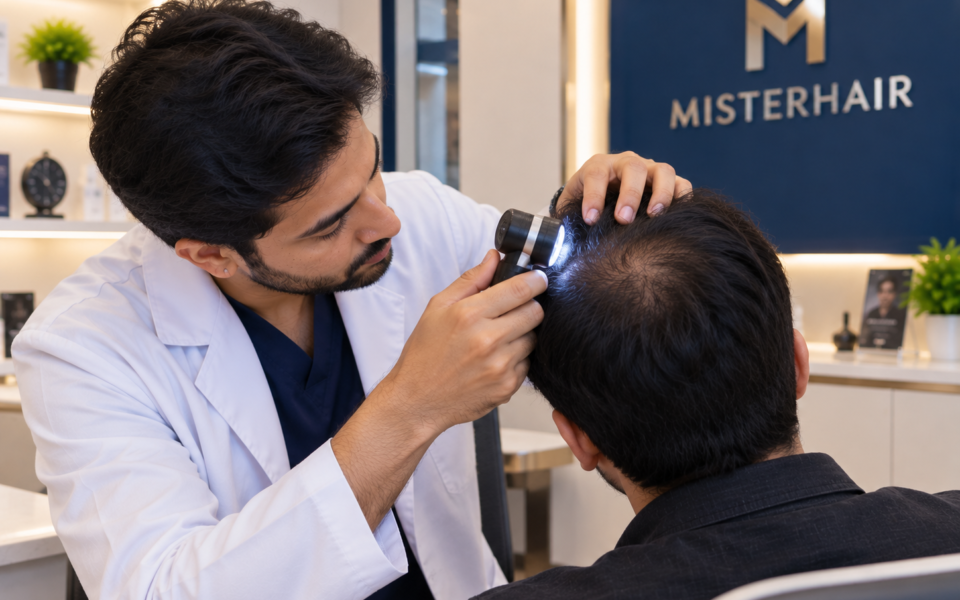
Before deciding on surgery, the doctor should assess the complete hair-loss pattern.
A useful consultation should consider:
- Crown thinning
- Frontal hairline
- Mid-scalp density
- Donor area
- Hair calibre
- Miniaturisation
- Family history
- Previous treatments
- Future hair-loss considerations
MisterHair’s 8-Point Hair & Scalp Analysis is designed to evaluate these factors and help determine whether surgical, non-surgical or no treatment is appropriate.
Building a long-term hair restoration plan
Crown restoration should not be viewed independently from the rest of the scalp.
A patient may eventually experience changes in other areas, particularly when pattern hair loss is progressive.
A long-term plan can help preserve donor resources and maintain a balanced appearance as the hair changes over time.
This is particularly relevant for younger patients and people with a strong family history of progressive hair loss.
Frequently Asked Questions
Can a hair transplant restore crown hair?
A transplant can restore hair to a thinning crown when the patient has suitable donor follicles and the underlying hair-loss pattern makes transplantation appropriate.
How many grafts are needed for a crown hair transplant?
The number varies according to crown size, existing hair, donor density, hair thickness and desired coverage.
Is crown transplantation different from a hairline transplant?
Yes. Crown restoration requires planning around the natural whorl and changing direction of hair growth, while frontal restoration focuses more heavily on hairline shape and transition.
Can crown hair continue to thin after transplantation?
Yes. Existing non-transplanted hair can continue to thin depending on the underlying hair-loss condition.
Does crown transplantation provide immediate density?
No. Hair growth develops gradually after the procedure, so the early postoperative appearance is not the final result.
Is DHI suitable for crown restoration?
DHI may be considered for appropriate patients, but technique selection depends on the individual’s hair characteristics and restoration plan.
Can early crown thinning be treated without a transplant?
Depending on the cause and stage of hair loss, non-surgical treatment may be considered before transplantation.
Crown Hair Restoration at MisterHair
If thinning around the crown is becoming noticeable, a proper assessment can help determine whether transplantation is appropriate or whether another treatment approach should be considered first.
MisterHair evaluates the overall hair-loss pattern, donor area and individual hair characteristics before developing a restoration plan.
MisterHair
Hair Restoration | DHI | Sapphire FUE | Hair Treatments
Call: 7338671338
Email: reachus@misterhair.in
Bangalore: Sadashivanagar | RR Nagar | Jayanagar | HSR | HRBR | Bannerghatta
← Back to all articles