Hair Transplant for Diffuse Thinning: How Treatment Planning Is Different
Hair loss does not always appear as a clearly defined bald patch or a receding hairline. Some people gradually notice that their overall scalp looks less dense, particularly under bright lighting or when their hair is wet. This pattern is commonly described as diffuse hair thinning.
For someone considering a hair transplant for diffuse thinning, the treatment plan needs to be approached differently from a case where a clearly bald area has already developed.
The reason is simple: diffuse thinning usually means that some hair is still present across the affected area. Those existing hairs need to be considered alongside the donor supply, hair-loss progression and the patient’s long-term restoration goals.
A detailed assessment is therefore an important first step before deciding whether transplantation is appropriate.
Understanding diffuse hair thinning
Diffuse thinning refers to a reduction in hair density across a broader area rather than hair loss being concentrated in one clearly defined region.
It may be noticeable across areas such as:
- Frontal scalp
- Mid-scalp
- Crown
- Several areas at the same time
The hair may become progressively finer before obvious baldness develops.
This can make diffuse hair loss difficult to judge simply by looking at the scalp. Someone may still have substantial hair coverage while experiencing significant miniaturisation underneath.
Existing hair changes the transplant strategy
A transplant into a completely bald area is relatively straightforward to visualise because there is little or no native hair occupying the recipient area.
Diffuse thinning is different.
The recipient area may contain:
- Normal-looking hair
- Fine hair
- Miniaturised hair
- Uneven density
- Hair that may continue thinning
New grafts therefore have to be planned around existing follicles.
The objective is not simply to add as many grafts as possible. The doctor needs to determine where additional follicles can provide useful improvement while protecting the existing hair.
Diagnosis comes before transplantation
Diffuse thinning can have different causes.
Pattern hair loss is one possibility, but diffuse shedding can also occur with nutritional problems, medical conditions, certain medications, stress-related shedding and scalp disorders.
This is why someone experiencing widespread thinning should not automatically assume that a hair transplant is the first treatment they need.
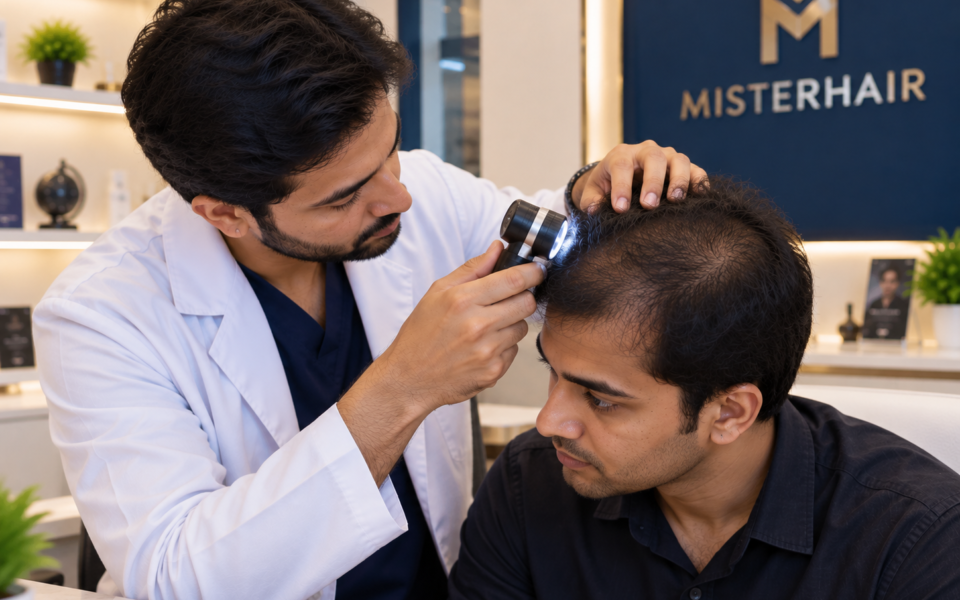
MisterHair’s 8-Point Hair & Scalp Analysis evaluates hair-loss grade, donor density, scalp condition, hair-shaft characteristics, miniaturisation and other relevant factors.
The assessment can help determine whether surgical treatment, non-surgical treatment or no treatment is appropriate.
Miniaturisation is an important part of assessment
Hair miniaturisation occurs when individual hairs gradually become finer.
A scalp can therefore appear reasonably covered while the hair itself has become weaker and less substantial.
In diffuse thinning, identifying miniaturisation is particularly useful because the visible density does not always tell the complete story.
If a significant number of native hairs are progressively becoming thinner, the long-term treatment plan needs to account for that progression.
Donor hair becomes especially important
Every hair transplant depends on the availability of suitable donor follicles.
The donor area is generally located toward the back and sides of the scalp.
During assessment, the doctor may consider:
- Donor density
- Hair calibre
- Follicular-unit characteristics
- Donor-area stability
- Existing miniaturisation
- Potential future requirements
A person with diffuse thinning across both the recipient and donor areas may require particularly careful planning.
The available donor supply should be allocated strategically rather than used simply to maximise immediate density.
Graft planning is based on the treatment area
There is no standard graft number for diffuse thinning.
The requirement depends on the size of the affected area and the patient’s individual hair characteristics.
Factors include:
- Degree of thinning
- Size of the affected scalp
- Existing native hair
- Hair thickness
- Donor density
- Desired improvement
- Future hair-loss pattern
Someone with mild frontal thinning may need a very different plan from someone with diffuse thinning across the frontal, mid-scalp and crown regions.
This is why an exact graft number should be determined after assessment rather than selected from a generic package.
Natural density is not the only goal
A common misconception is that the objective of transplantation is to recreate the density a person had in their teenage years.
In reality, donor hair is limited.
The doctor needs to balance visible improvement with preservation of donor resources for possible future needs.
Hair thickness also affects visual coverage. Thicker hairs can create greater visual fullness than very fine hairs even when the follicle count is similar.
For diffuse thinning, the goal is therefore usually to create meaningful improvement while working within the patient’s biological limitations.
Hairline and mid-scalp planning may need to work together
Diffuse thinning can affect more than one region.
A person may have:
- Mild frontal recession
- Reduced mid-scalp density
- Early crown thinning
Treating only one small area without considering the surrounding scalp can create an imbalance as hair loss progresses.
A comprehensive plan considers the relationship between the hairline, mid-scalp and crown.
This is particularly important when the patient is relatively young or has a history of progressive hair loss in the family.
DHI and Sapphire FUE can be considered after assessment
MisterHair offers both DHI and Sapphire FUE hair-transplant options.
The choice is not based simply on whether the patient has diffuse thinning.
It depends on factors such as:
- Hair-loss pattern
- Existing density
- Donor characteristics
- Graft requirements
- Restoration goals
- Areas being treated
More information about these techniques is available on the MisterHair Hair Transplant page.
The important point is that the procedure should follow the assessment, rather than choosing a technique first and trying to fit the patient into it.
Non-surgical treatment may also have a role
Diffuse thinning can sometimes involve a large amount of native hair that is still present but weakened.
Depending on the underlying cause, a doctor may recommend non-surgical treatment to support the existing hair.
MisterHair provides PRP Hair Treatment as one of its non-surgical hair-treatment options.
The suitability of PRP or another treatment depends on the individual’s diagnosis and overall hair condition.
A transplant and non-surgical treatment are not necessarily mutually exclusive. In some cases, they may form different parts of a longer-term restoration plan.
Future hair loss needs to be considered
Diffuse thinning can progress.
If the patient undergoes transplantation while native hair is continuing to miniaturise, additional thinning may occur around the transplanted area later.
This is why long-term planning is particularly important.
A doctor may consider:
- Current hair-loss stage
- Family history
- Donor supply
- Existing miniaturisation
- Age
- Potential progression
The aim is to avoid using a large proportion of the donor supply simply to address the appearance of the scalp at one particular point in time.
Recovery does not determine the final result immediately
After transplantation, the newly placed follicles require time to settle and enter their growth cycle.
The early appearance should therefore not be considered the final result.
Patients should follow their postoperative instructions carefully and attend recommended follow-ups.
The eventual appearance depends on the patient’s healing, follicular characteristics, graft placement and ongoing condition of the surrounding native hair.
A personalised assessment makes the difference
Diffuse thinning is one of the situations where an individual assessment is particularly valuable.
Rather than asking only how many grafts are available, the consultation should establish:
- Why the hair is thinning
- How extensive the thinning is
- How strong the donor area is
- How much native hair remains
- Whether miniaturisation is present
- Whether the loss is still progressing
- Which treatment options are appropriate
This allows the restoration plan to be built around the patient’s actual hair rather than a standard template.
Frequently Asked Questions
Can diffuse thinning be treated with a hair transplant?
Some patients with diffuse thinning may be suitable for transplantation, but suitability depends on the cause, donor supply, native hair and stability of the hair loss.
Is diffuse thinning the same as baldness?
No. Diffuse thinning generally involves reduced density across an area while significant amounts of hair may still remain.
How many grafts are needed for diffuse thinning?
There is no fixed number. Graft requirements depend on the size and severity of thinning, donor density, hair characteristics and restoration goals.
Can existing thin hair remain after a transplant?
Yes. Transplantation adds follicles to selected areas; existing native hair may continue to change depending on the underlying hair-loss condition.
Is DHI suitable for diffuse hair thinning?
DHI may be considered for suitable patients, but the appropriate technique depends on the individual’s assessment and restoration requirements.
Can diffuse thinning be treated without a transplant?
Depending on the cause, non-surgical treatment may be appropriate. A professional assessment should determine the underlying problem before surgery is considered.
Does diffuse thinning continue after a hair transplant?
It can. Native hair that has not been transplanted may continue to thin depending on the underlying condition.
Hair Restoration Assessment at MisterHair
Diffuse thinning requires more than simply counting the visible hairs on the scalp.
MisterHair’s assessment looks at the overall hair-loss pattern, donor area, hair characteristics and potential treatment options before recommending a restoration approach.
MisterHair
Hair Restoration | DHI | Sapphire FUE | Hair Treatments
Call: 7338671338
Email: reachus@misterhair.in
Bangalore: Sadashivanagar | RR Nagar | Jayanagar | HSR | HRBR | Bannerghatta
← Back to all articles