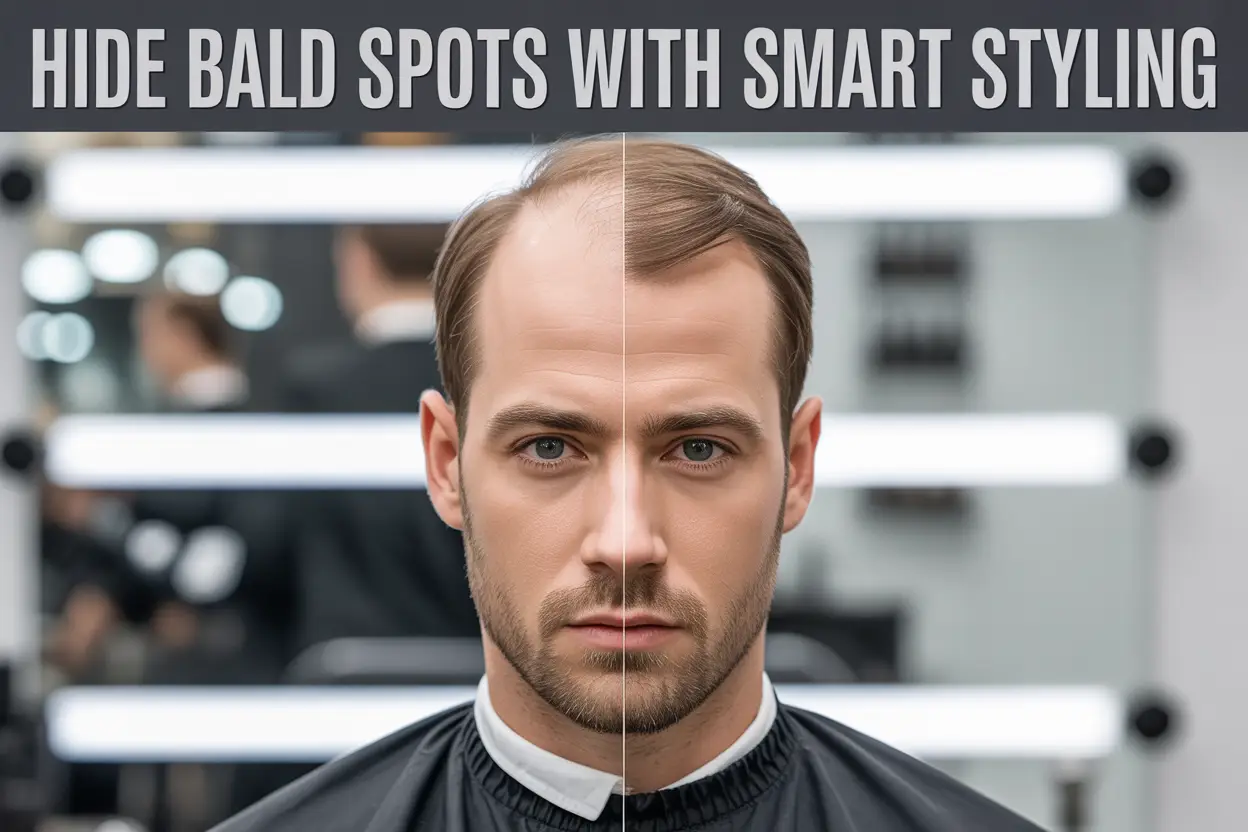
Dealing with bald spots doesn’t mean you have to sacrifice style or confidence. Men experiencing hair thinning, receding hairlines, or patchy hair loss have plenty of effective options to maintain a polished appearance.
Who this guide helps: Men at any stage of hair loss who want practical styling solutions without major treatments or procedures.
What we’ll cover: First, the different types of bald spots and hair loss patterns so you know exactly what you’re working with. Then, strategic haircut styles that minimise bald-spot visibility and specific styling techniques to camouflage thinning areas — so you walk away with actionable strategies to look your best while working with your natural hair.
Understanding Different Types of Bald Spots and Hair Loss Patterns

Male Pattern Baldness and Crown Thinning
Male pattern baldness affects a large share of men by age 50, creating the classic horseshoe-shaped pattern. The crown area typically shows the first signs of thinning, starting with a small circular spot that gradually expands outward. This predictable pattern makes it easier to plan styling strategies — and many men in their thirties, including in India, look for simple ways to hide a thinning crown.
Crown thinning presents unique challenges because it sits at the highest point of your head, visible from multiple angles. Early-stage crown thinning responds well to longer top layers that can be swept across the area, while more advanced thinning may require shorter, textured cuts that create visual density.
Receding Hairlines and Temple Area Coverage
Receding hairlines create distinct patterns, from slight temple recession to more pronounced M-shaped hairlines. The temporal area loses density first, and because the front hairline frames your face, it impacts your overall appearance significantly. Temple recession can be managed through strategic parting and layering — side-swept styles work particularly well, drawing attention away from the receded areas while maintaining a natural look.
Alopecia Areata and Patchy Hair Loss

Alopecia areata creates different challenges with its unpredictable, circular bald patches that can appear anywhere on the scalp. Unlike male pattern baldness, these patches are typically smooth and completely hairless, making them harder to camouflage with traditional styling. The size and location of patches determine whether growing surrounding hair longer for coverage is viable, or if shorter, textured styles work better to minimise contrast.
Diffuse Thinning Throughout the Scalp
Diffuse thinning creates overall density reduction without following specific patterns, making hair appear flat rather than creating distinct bald spots. It often accompanies stress, nutritional deficiencies, or hormonal changes, making it potentially reversible with proper treatment. Styling focuses on maximising perceived thickness through texturising techniques, strategic layering, and volumising products.
Strategic Haircut Styles That Minimise Bald Spot Visibility

Buzz Cuts and Ultra-Short Styles for Even Coverage
Ultra-short haircuts work well for men dealing with patchy hair loss. At a uniform length of 1/8 to 1/2 inch, the contrast between thick and thin areas virtually disappears, creating a clean, intentional look. A classic buzz cut (a #2 or #3 guard) is the most foolproof option; a #1 guard creates an even smoother transition for more advanced thinning. Crew cuts offer a slightly longer variation that works well for crown thinning.
Key benefits:
- Requires minimal daily styling
- Grows out evenly without awkward phases
- Works with any hair texture
- Ages gracefully as hair loss progresses
- Professional appearance suitable for any workplace
Textured Crops That Add Volume
Textured crop cuts create the illusion of fuller hair through strategic layering. The modern textured crop features longer hair on top (typically 2–4 inches) with shorter, faded sides; point-cutting creates irregular, choppy ends that add natural-looking volume and prevent hair from lying flat against the scalp. Disconnected layers create shadow and depth, so hair pieces overlap and appear denser.
Styling tips for textured crops:
- Use sea salt spray on damp hair for natural texture
- Scrunch hair while blow-drying to enhance volume
- Apply matte pomade for hold without weighing hair down
- Avoid over-brushing, which flattens the textured effect
- Sleep on a silk pillowcase to maintain morning texture
Side Parts That Redirect Attention
Strategic side parts leverage the eye’s natural tendency to follow strong directional lines: a defined part draws attention along that line instead of toward thinning areas, making side-part styles one of the most effective ways to hide bald spots. A deep side part is especially useful for crown thinning or temple recession — position the part about two inches from your natural hairline and sweep longer hair across problem areas.
For More Information Contact Us : 73386 71338
This technique works best with hair that’s 3–6 inches long on top. For widow’s peaks or receding hairlines, start the part from the highest point of your hairline and angle toward the opposite ear for a diagonal sweep that camouflages uneven hairlines.
Optimal side-part placement by hair-loss type:
| Hair Loss Pattern | Part Placement | Hair Length Needed |
|---|---|---|
| Crown thinning | 2 inches from centre | 4-6 inches |
| Temple recession | From hairline peak | 3-5 inches |
| Diffuse thinning | Natural cowlick location | 5+ inches |
| Vertex balding | Deep left or right | 6+ inches |
Side parts require daily maintenance — a quality pomade or styling cream provides hold without a helmet-like appearance.
Hair Styling Techniques to Camouflage Thinning Areas

Proper Blow-Drying for Maximum Volume
The right blow-drying technique transforms thin-looking hair into a fuller style. Start with towel-dried, slightly damp hair and apply a volumising mousse or root-lifting spray at the roots. Hold the dryer at a 45-degree angle and lift sections up and away from the scalp with a round brush to create root lift — don’t blow dry straight down, which flattens everything. Use the cool-shot button to set each section, and for the crown, flip your head upside down while drying for maximum lift.
Strategic Use of Hair Products
Lightweight volumising mousses and root-lifting sprays add body without weighing hair down; heavy creams and oils flatten hair and make thin spots more noticeable. Dry shampoo adds texture and grip to clean hair. Hair fibres and building powders cling to existing strands to create the illusion of density — apply after styling, then lightly mist with hairspray.
Essential products for thinning hair:
- Volumising mousse (lightweight formula)
- Root-lifting spray
- Dry shampoo for texture
- Hair fibres or building powder
- Flexible-hold hairspray
- Sea salt spray for grit and texture
Combing and Brushing Techniques

Never brush wet hair aggressively — wet hair is weaker and prone to breakage, which can worsen thinning. Use a wide-tooth comb and gently detangle from the ends upward to protect the roots. Combine gentle combing with the right haircut: textured crops, short fades, or layered styles create volume and reduce scalp visibility.
When styling, use a boar-bristle brush to smooth hair over sparse areas and distribute natural oils, and backcomb gently at the roots for volume.
For More Information Contact Us : 73386 71338
Brushing best practices:
- Use boar-bristle brushes for smoothing
- Comb wet hair gently with wide teeth
- Backcomb lightly for volume
- Experiment with different part placements
- Brush in the direction that maximises coverage
Advanced Hair Solutions and Treatments

Hair Fibres and Concealing Powders for Instant Results
Hair fibres and concealing powders offer immediate camouflage without commitment or recovery time, clinging to existing strands through static to create the appearance of fuller hair in seconds. Keratin fibres are the most popular option and come in multiple shades — shake over thinning areas and gently pat to distribute, building coverage gradually. Concealing powders allow more precise application for smaller spots.
Best application tips: apply to completely dry hair, use a setting spray to lock fibres in place, choose a shade slightly lighter than your natural colour, and remove thoroughly before washing to prevent buildup. Note they aren’t truly waterproof, require daily reapplication, and can transfer onto pillows or clothing.
Hair Transplant Options and Realistic Expectations
Hair transplants are the gold standard for permanent restoration, but success depends on realistic expectations and proper candidate selection. FUE extracts individual follicles from donor areas and leaves tiny, barely visible scars with a 7–10 day recovery; FUT removes a thin strip, leaving a linear scar but often yielding more grafts per session.
Realistic timeline:
- Initial healing: 2 weeks
- Transplanted hair sheds: 2–6 weeks (normal)
- New growth begins: 3–4 months
- Noticeable results: 6–8 months
- Final results: 12–18 months
At Mister Hair, per-graft pricing is the same across every branch — FUE ₹30–45, Sapphire FUE ₹40–55, DHI ₹45–65 — and most patients need 1,500–3,000 grafts, putting all-inclusive packages around ₹1.2L–₹3L with no-cost EMI from ₹4,999/month. Good candidates have sufficient donor hair, realistic expectations, and stable hair loss.
For More Information Contact Us : 73386 71338
Scalp Micropigmentation as a Permanent Solution
Scalp micropigmentation (SMP) creates the illusion of hair follicles through specialised tattooing, depositing tiny pigment dots into the upper dermis that mimic short hair from normal viewing distances. It works exceptionally well for men who prefer a buzz-cut look or want to add density, typically over three sessions spaced 4–6 weeks apart.
SMP works best for complete baldness, receding hairlines, crown balding, scar concealment, and adding density. It delivers immediate results with no ongoing maintenance, though it requires touch-ups every 3–5 years and suits short hairstyles. The best practitioners specialise exclusively in SMP, as the techniques, equipment, and pigments differ from traditional tattooing.
According to Dr. Saranya Thulasidoss, Clinical Lead at Mister Hair, combining the right cosmetic technique with professional scalp expertise delivers the most natural-looking, confidence-restoring results for men dealing with baldness.
Maintenance and Daily Hair Care Routines

Gentle Washing Techniques
Skip the daily shampoo routine — your scalp’s natural oils help protect and strengthen remaining hair, so aim to wash every other day. Use lukewarm rather than hot water, apply a gentle, sulfate-free shampoo to the scalp (not the strands), and massage with fingertips, never nails. Rinse completely to avoid product buildup that can clog follicles, condition only mid-lengths and ends, and pat dry with a soft microfibre towel or cotton t-shirt rather than rubbing.
Protective Products That Support Scalp Health
Look for shampoos containing ketoconazole, which has anti-inflammatory properties and may help reduce scalp irritation. Scalp serums with caffeine, niacinamide, or peptides can improve circulation; apply to a clean, slightly damp scalp before bed. Heat-protectant sprays are non-negotiable if you use heated tools.
| Product Type | Key Ingredients | Benefits | Frequency |
|---|---|---|---|
| Scalp Serum | Caffeine, Peptides | Improves circulation | Nightly |
| DHT-Blocker Shampoo | Ketoconazole, Saw Palmetto | Reduces hormone damage | 2-3 times weekly |
| Volumising Mousse | Biotin, Panthenol | Adds thickness appearance | Daily styling |
| Heat Protectant | Silicones, Proteins | Prevents thermal damage | Before heat styling |
Regular Styling Maintenance
Consistency matters. Apply volumising products to damp hair, working them through with your fingers. If your style relies on longer hair to cover sparse areas, trim every 4–6 weeks to maintain the right length ratios — overgrown hair can make thinning more obvious. Keep a travel-sized styling product for midday touch-ups, and clean your brushes weekly to remove buildup.

Conclusion
Dealing with bald spots doesn’t mean you’re out of styling options. The right haircut can make thinning areas less noticeable, while smart styling techniques create the illusion of fuller hair. From strategic cuts that redirect attention to professional treatments that address the root cause, there are plenty of ways to feel confident about your appearance again.
The key is finding what works for your specific pattern and sticking to a routine. Don’t be afraid to experiment with different styles or talk to a professional who understands thinning hair.
For More Information Contact Us : 73386 71338
← Back to all articles